Monday

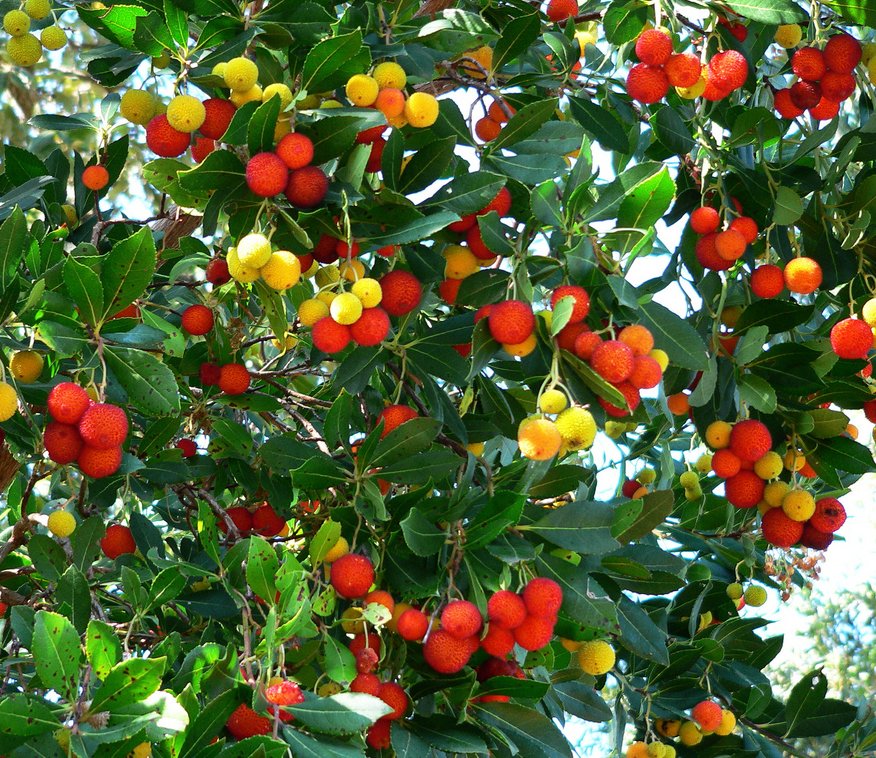
The Killarney Strawberry Tree

Isn't this lovely!

The strawberry tree is native to Ireland, southern Europe and the western Mediterranean region (Turkey, Greece, Lebanon) where it grows in rocky, well-drained soils.
The small white or pinkish blueberry-like flowers are assembled in drooping panicles about 2" (5cm) long. The spherical bright red fruits are warty and about 3/4" (2cm) in diameter. They take a year to ripen, and both flowers and fruits can be present at the same time.

Strawberry tree is 8 to 20+ ft (2.5m to 6m+) tall and wide. Full sun or partial shade (essential in desert areas). Makes a striking display as a specimen shrub. Great for Bonsai.

The bark of strawberry tree has been used in tanning leather. The fruit is edible. The fruits are prepared as jams, jellies, syrups, candied fruit, distilled and fermented drinks, such as wines (
Medronho) and liqueurs. Produces a rare, highly-esteemed honey in Sardinia.
Strawberry tree is tolerant of acidic to alkaline soils. Zones 8-11. Seeds found here


It's a challenge. Very finicky to grow, but well worth it! 

Digg this

Friday

Goblin Garden - The Mighty Alraun

Rare Mandrake Root Atropa Mandragora officinarum.

It's one of the oldest and most famous plant in witchcraft, rituals and medicinal use. It's also mentioned in several references in the bible. According to the legend, a dog had to pull up the man-like roots as their scream reputedly killed all who heard it! Today the plant is best known from the movie "Harry Potter".
This plant belongs to the nightshades family (Solanaceae) and all parts are poison.


Mandrakes are stemless, perennial herbs with dark green leaves, resembling somewhat the leaves of chard and a have large taproots that can grow up to two feet in length, resembling somewhat a human.
The pale to vibrant bluish purple flowers emerge in a cluster from the center of the plant. The fruit, orange to red berries, resembling tomatoes, ripen by late summer. The fruit is highly fragrant, one ripe fruit placed in the middle of the room will perfume the whole room with a pineapple like scent.

This plant is hardy to at least 20F when fully grown, it can be grown anywhere in the sub-tropics as long as there are cool winters there. It requires good drainage for best growth and is not too picky about soil types.
This plant gets dormant in the summer times. Every autumn the root grows a new rosette of leaves. The leaves grow fast and in only a month they are fully developed. Zone 7. Seeds available here

Digg this

Scarce Gem - Extremely Rare Sorcerer's Tree


What have we here.

 The Sorcerer's Tree (Solanaceae family) is a showy woody shrub, to 12ft high, native to a small area in southern Chile.
It has slightly glossy, elliptic leaves on spiny stems and pendulous, beautiful bell-shaped, 2in long, magenta flowers followed by round, yellow-ish fruits.
Latua pubiflora is apparently nowhere abundant, and there are even very few specimens of it in the world.

Seeds found here...
 

The Sorcerer's Tree as it is known, is one of the rarest of all shamanic plants.
All parts are strongly poisonous due to hallucinogen alkaloids.

For any rich, moist, well drained soil in a shady spot throughout the year.
Hardy to Zone 9. The plant does not tolerate snow, but can tolerate occasional freezing spells of about 23F (the typical morning frost of central Chile). Prefers to grow in the part-shade to full shade.


Family: Solanaceae. Synonyms: Lycioplesium pubiflorum, Latua venenata, Latua venenosa, Baum der Zauberer, Palo de Bruja, Tree of Wizards.


Digg this

Wednesday

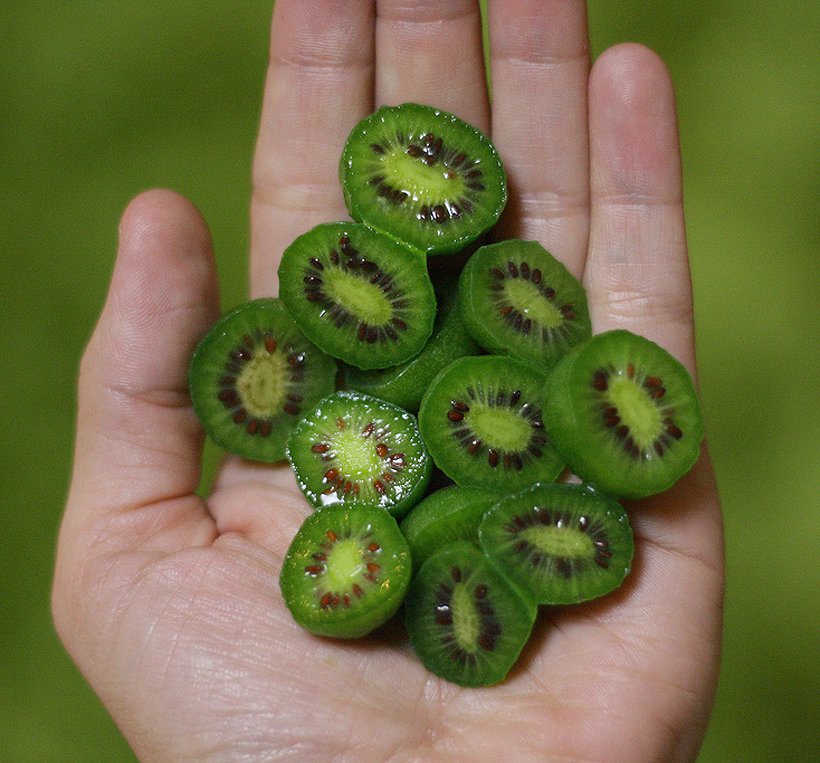
Mini Fruit Kiwi Berry Yum!!!

The self-pollinating Actinidia arguta is a heirloom perennial vine native to Japan, Korea, Northern China, and Russian Siberia. The fruit are referred to as Hardy kiwifruit, kiwi berry, arctic kiwi, baby kiwi, dessert kiwi, grape kiwi, northern kiwi, or cocktail kiwi and are edible. Berry or grape-sized fruit similar to kiwifruit in taste and appearance, but are green with smooth skin. Often sweeter than the kiwifruit, hardy kiwifruit can be eaten whole and need not be peeled.

The fast-growing, climbing vine is very hardy (hence the name hardy kiwi), and is capable of surviving slow temperature drops to -30°F, although young shoots can be vulnerable to frost in the spring. The vines need a frost-free growing season of about 150 days, but are not damaged by late freezes, provided that temperature changes are sufficiently gradual to allow plants to acclimate. Indeed, a period of winter chill is necessary for successful cultivation. However, rapid freezes will kill off buds and split vines. The vines can also be grown in low-chill areas. Seed available here.

The vines grow extremely quickly and require a strong trellis for support.

Digg this

Monday

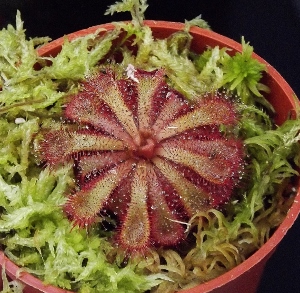
Carnivorous Spoon Sundew

Species of the Drosera spatulata group are found from New Zealand, Tasmania, and Australia.
Drosera tokaiensis is beautiful, small rosette-forming carnivorous plant species having spoon-like leaves up to 1 inch long. It is one of the easiest carnivorous plants to grow and care. As a natural hybrid between D. spatulata and D. rotundifolia it has the best genes for adaptation to new environments. It is a free-flowering and fascinating house plant that may bloom after short 8 months after sowing. The plant lives 3 years or more, producing seedlings during the way!
The leaves are densely covered with stalked tentacles that secrete sticky mucilage with enzymes to attract and catch inserts. The tentacles are very sensitive and mobile. Once an insect is trapped on a leaf, its movements contact triggers a curling reaction. The leaf wraps around the insect and produces more digestive glands in contact with its prey, eventually digesting and absorbing the victim's nutrients until only the external skeleton remains.
This is a subtropical species, suitable zone 10+ or as a houseplant. Seeds found....

Digg this

Thursday

Beautiful Chilean Potato Vine 'Glasnevin'

Lovely!

Solanum crispum is a species of flowering plant in the Solanaceae family, native to Chile and Peru. Common names include Chilean potato vine, Chilean nightshade, Chilean potato tree and potato vine. Growing to 20 ft tall, it is a semi-evergreen, woody-stemmed climbing plant. The small blue fragrant flowers, 1”  in diameter, with prominent yellow ovaries, appear in clusters in summer. They resemble those of the closely related potato.
S. crispum is fast growing with a long flowering period, typically from midsummer till autumn. It grows well in neutral or slightly alkaline soils that are moist and well drained. Requiring some protection from frost, planting it against a south- or west-facing fence or wall in full sun is recommended. Zone 8+


Seeds available here

Digg this

What a stinking Lily!! - Voodoo Lily

If you like the smell of death and decay in the garden, this one might be of interest to you. The little sister of the giant corpse flower.

The Voodoo lily is a member of the philodendron family that grows from a tuber. Each tuber produces a single tripartite leaf on a tall, mottled stem. Voodoo lily is a perennial generally grown as a curiosity for its interesting foliage.
But be aware; When in bloom it produces an odor like a dead animal, the smell intended to attract the carrion flies that are its natural pollinators. If this is objectionable the flower can be cut off or covered with a plastic bag to confine the smell. Pollinated flowers will be followed by a round berry.

As a tender plant, the leaf is very frost sensitive (although buried tubers are supposedly hardy to zone 6), and must be grown indoors as a house plant
(oh joy!) or as a seasonal outdoor plant. It is easy to plant the tubers outdoors once the soil has warmed and dig them again in the fall once the weather cools. Also known as konjak, konjaku, konnyaku potato, devil's tongue, voodoo lily, snake palm, or elephant yam.

This variety is grown for food. The corm has dietary and medicinal uses and provides several vitamins, but must be used only after careful research.


Definitely worth growing for it's unique display and 'fragrant' experience, a true conversation plant.

Bulbs available here

.

Digg this

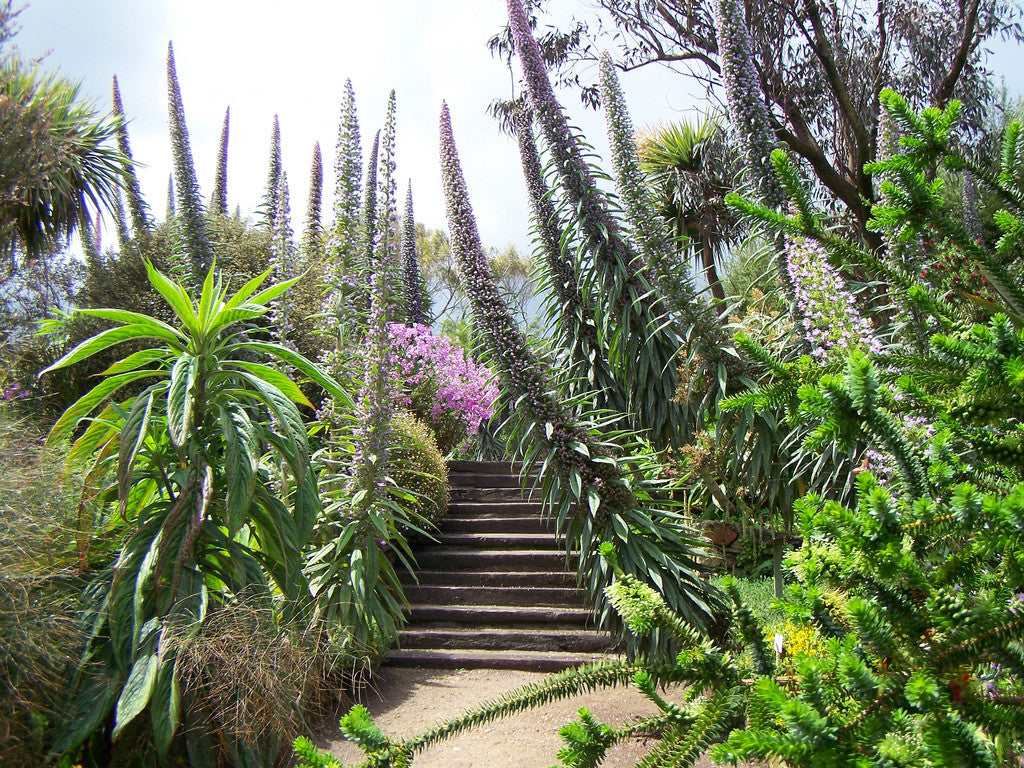
Dr. Seuss Trees - Tree Echium


Probably the drama queen of the Echiums...


Echium pininana, also called Tree Echium and Giant Viper's bugloss, is a plant, native to La Palma in the Canary Islands. 

E. pininana is a biennial or triennial, showing little more than leaf in the first year, but subsequently produces a dense, 10-12 ft high (potentially) flower spike that carries a dense mass of leaves and small blue flowers. Attracts many Hummingbirds, Bees, Butterflies.


The tree echium is a showy plant, that will withstand negative temperatures down to 26°F - 25°F (-3°C to -4°C) - zone 8+


Inflorescence of the tree echium appears in the beginning of the second spring. Resembling a Palm tree, the stem quickly reaches up to 10-12 ft tall, and bears numerous tiny blue-violet flowers. 


Certainly the most sought-after of all Echium species that will bring crowds flocking to see it. Stunning!


Seeds...

Digg this

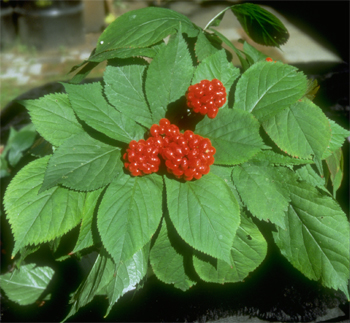
American Ginseng Panax quinquefolius

Panax quinquefolius roots have become a very popular herbal medicine, especially in China. As a result of its over-exploitation and the loss of its natural forest habitat, it is now rare in the wild, and material used commercially has to come from cultivated plants. It is now considered to be a threatened species in 16 states and endangered in a further 10 states. 

American ginseng (Xi Yang Shen),  Panax quinquefolius. The word "panax" comes from the Greek word "pan" meaning "all", and the Greek "akos" meaning "cure", or "cure all", which exemplifies the high regard for this herb. Ginseng plants have glossy green leaves and grow to about 2 feet tall and wide. 
They have a thin, single stem that emerges from the top of the root that shrinks each year as the plant grows. This causes wrinkles or rings at the top, or neck, of the root and is the most accurate way to date the age of a ginseng root after harvest. In most climates seedlings are best grown in a deep pot in a greenhouse or cold frame for the first winter, then can be planted in a permanent location in late summer. The plant is perennial and hardy to USDA zone 6. Prefers moist humus rich soil in semi shade to full shade.

Pre-chilled, already stratified Seeds

Digg this

Wednesday

The Dove Tree, also called Handkerchief Tree or Ghost Tree

Native to China, handkerchief tree is considered to be the Holy Grail of exotic flora, and seeds were first sent to England by the legendary botanist Ernest Wilson in 1901. The dove tree is a deciduous tree that typically grows 20-40’ tall with a broad pyramidal habit. Red-anthered flowers in rounded clusters bloom in April-May. However the showy parts of the bloom are the large showy white bracts (one 3-4 inches long and the other 6-7 inches long) which subtend each flower cluster. The bracts flutter in the slightest breeze, and, from a distance, purportedly look like white doves sitting in the tree, hence the common name. Flowers are followed by round, greenish-brown, golf ball-sized fruits on 2-3” stems. 
The bright green leaves (3-6” long) are heart-shaped at the base. Variable fall color ranges from undistinguished dull pastels to bright oranges and reds. Other common names, all in reference to the unique flowers, include handkerchief tree, laundry tree and ghost tree. Genus honors Abbe Armand David, a French missionary to China from 1862-1873, who first described and collected the tree. This Tree is hardy Zone 5-8

Digg this

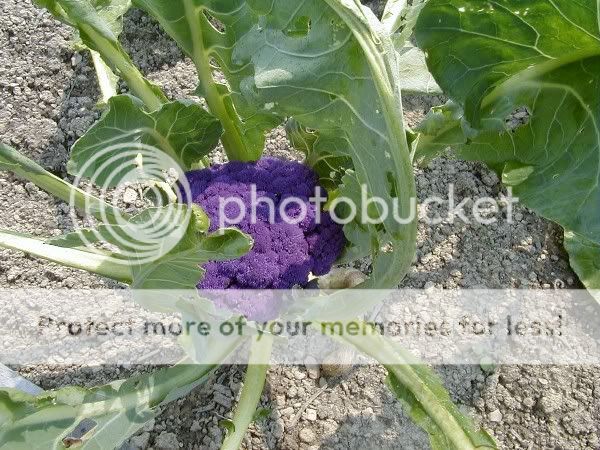
Dark Purple Cauliflower..Yum!

Look what we have here...

This specialty market variety will certainly attract attention at your garden and kitchen.
This rare and stunning hybrid F1 cauliflower produces rich colored heads for cropping July-October. The unique purple curds can be eaten raw, boiled, steamed or stir-fried. The deep purple color along with its dark green leaves makes for a very striking combination. Works best for fall planting but can also be grown in spring. Tender texture and mild cauliflower flavor. Superior quality retain most of their vibrant color even after cooking - a beautiful presentation!
Purple cauliflowers contain anthocyanins a very powerful antioxidant, said to help prevent cancer and very beneficial for general health. 80 days from setting out transplants


Seeds: Graffiti Cauliflower 

Digg this

Friday

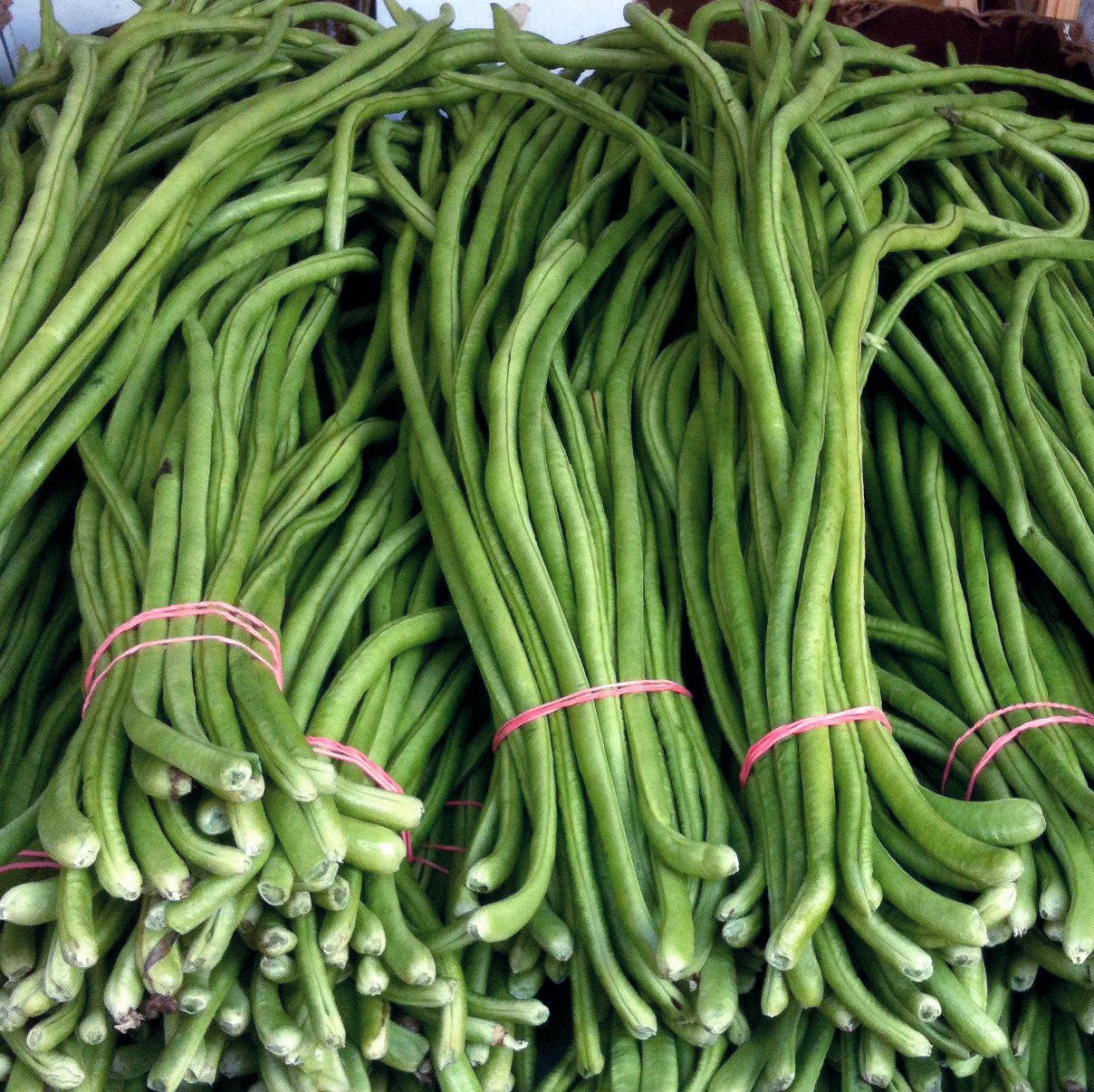
Heirloom Bean Yard Long Vigna Unguiculata Sesquipedalis

The coolest new bean in my assortment. 

It is doing extremely well in the Texas heat. Another great feature is the bend ability that lets you create wondrous eye appealing edible conversation material. 

Unique and delicious, yard long beans grow extra long with super slender pods that are a tasty addition to stir-fries and stews. This variety produces long, dark green, slender, round string-less pods that grow 16-18" (to 45 cm) long. This strong, easy to grow plant needs a warm climate to thrive and will reward you with high yields. They are very
crisp, tender and delicious. Try in recipes that use snap beans. Prepare by cutting into 2" sections. Shell mature pods and use as dried beans. 70 Days Also known as Chinese long bean, garter bean, snake bean, spaghetti bean, yard long bean, asparagus bean.

Yard Long Bean Seeds

Digg this

Thursday

Incredible Maniltoa


Latest stunning discovery.

The Australian Manitloa is a highly ornamental small tree with very spectacular, cascading pink new growth. As an added attraction to the spectacular new foliage growth it will produce fluffy white balls of flowers. It will grow into a medium size tree suitable for suburban back yards. 


They produce a brown pod containing one brown seed, probably one of the reasons why no one sells them.


Common names include: Silk Handkerchief Tree, Cascading Bean, Native Handkerchief Tree.


Digg this

Tuesday

Edible Ornamental Loroco Fernaldia pandurata

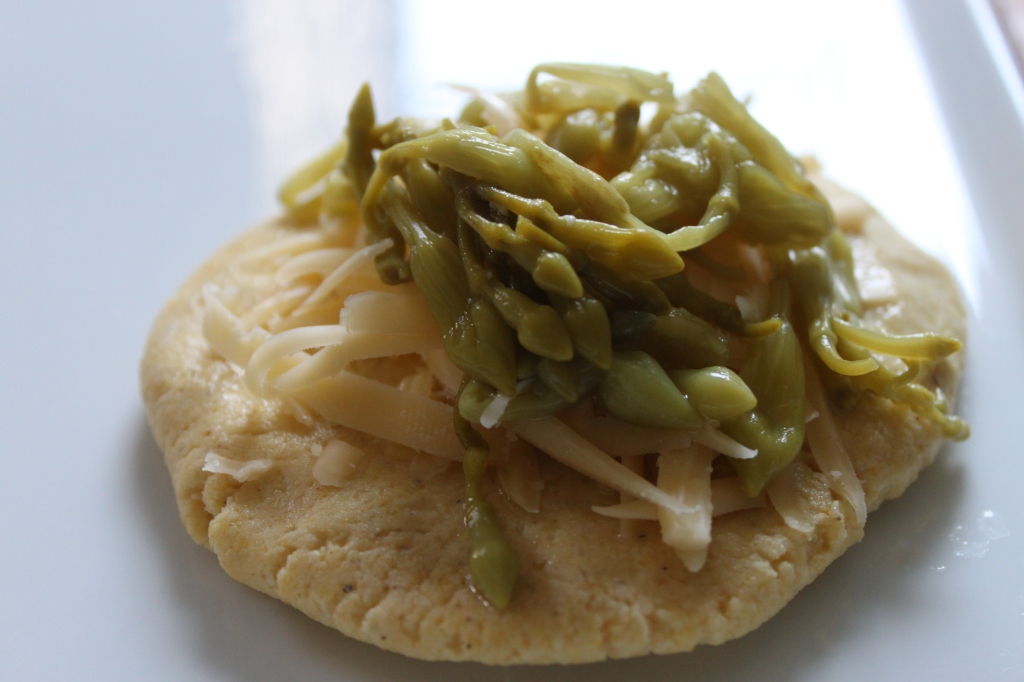
Loroco is native to Central America, and was called Quilite, which in the indigenous language means “Edible herb”. It is a perennial plant that produces flowers from May to October in El Salvador, but with irrigation can produce year-round. The Loroco plant is a tropical flowering woody vine with ornamental flowers. It grows wild in El Salvador, Guatemala, Honduras, and Nicaragua, and prefers a temperature range between 68 and 90 F.

The flowers are harvested and used in the cuisine of El Salvador and some other countries in Central America. It has a unique, pungent flavor that is used in 'pupusas', a corn-based food popular in El Loroco. Loroco tastes "green" with overtones of nuts. The closest taste perhaps to compare the "green" part to is chard, or a cross between mild broccoli and squash

Loroco is propagated principally by seed, but can also be propagated by cuttings. It takes about three to four months from seed to flowering.

The leaves can be 1 1/2 to 8 1/2 inches (4 to 22 cm) long and 1 1/2 to 5 inches (1 1/2 to 12 cm) wide. The vine produces flowers in clusters of 10 to 32, averaging 25 per cluster, that in turn, if unharvested, produce pods up to 13 inches (34 cm) long. Seeds are very hard to find. Scarce Seeds available here.


.

Digg this

Friday

Chilean Zabala Fruit Lardizabala funaria

For its foliage, for its flowers and for its fruit, this plant from Chile is just full of interest. A very handsome and vigorous, twining climber, it has very ornamental, dark green, glossy, leathery leaves (some folk grow it just for this) and bears very late in the year drooping clusters of very striking and fascinating, dark chocolate flowers.
The Flowers are followed by equally fascinating, dark purple, sausage-shaped fruits two or three inches long. The fruits are sweet, pulpy and edible and are sold in markets in Chile where they are much appreciated.
Although they will tolerate a temperature as low as 14°F (-10°C), give it the warmest, most sheltered spot in your garden. A cool unheated greenhouse will do just as fine. 

Seeds....

Digg this

How to Test older Seeds for Germination

Common Vegetable Seeds:
 

Nobody wants to plant dead seeds but just because it’s old doesn’t mean it won’t grow. Some seeds will germinate and grow for up to 5 years after the date they came from the field. And, at the price of quality food plot seed, it’s worth a second look.

It depends upon what kind of seed it is, how it was cared for, and how it was stored. Seed  should be kept cool, dry, and clean and protected from pests and insects in some sort of protective container. 

Food seeds can be broken into 2 categories: hard seeds and soft seeds. Hard seeds are hard to the touch and generally store quite well. Soft seeds are softer to the touch and typically do not have a hard coating to protect them. They don’t store particularly well even under ideal conditions

The best way to find out if the seed is still good is by testing germination. Testing seed is simple and you will know if you have good seed in a few days. Spread the seed in question on a moist paper towel. Use about a half dozen seeds (depending on size) per square inch.

Moisten and cover the seeds with another paper towel. Cover with saran wrap or place in a zip lock bag to help keep the medium moist. Be sure to establish and maintain contact between the seed and the testing medium you have placed the seeds on. Keep the whole thing moist, warm to the touch, and provide plenty of light. Basically, you are trying to simulate growing conditions and most seeds won’t germinate in soils below 60 degrees.

In a day or two most of the viable seeds will swell, crack open and start sending out roots and shoots. That’s the germination you are looking for. If nothing happens for a week, the seed you are testing is probably dead (unless you have allowed the seeds to dry out, or drown, and die).

This method may not always apply to exotic, tropical and rare type of seeds. Follow special instructions on those.

Digg this

Monday

How about them Apples...Berry Tomatoes

Tiny weeny miniature tomatoes. How cute! I am going to grow a bunch in small hanging baskets and then gift them, They will be hit with kids!

This vigorous rare tiny wild tomato Solanum pimpinellifolium is like no tomato you've ever seen before!
Perfect for baskets, window boxes or raised patio containers, the cascading plants live up to their name, producing literally thousands of sweet, juicy, bite-sized tomatoes in an inexhaustible supply throughout the summer!
They are the tiniest of the tomato family, measuring only about 10mm in diameter, sweet and crisp flesh, almost explore in your mouth, delightful and to die for! It is considered to be the wild form of many- perhaps even all- cultivated tomatoes. Great for use as a unique garnish,
much sought after by gourmet restaurants. 


Note that although these are a different species, they will readily cross with other tomatoes. If you are saving seed, isolate these plants.  Seeds found here....


Digg this

Friday

The Amamzing Kaka Beak Plant

Clianthus is an attractive semi-evergreen scrambling shrub with pinnate leaves and spectacular claw-like flowers in spring and summer.

This exotic shrub puts on a magnificent show. Now extinct in the wild, it produces dense masses of bright pink and red showy flowers-up to 15 in a bunch, suspended from arching branches.

A spreading, fast-growing shrub with fern like foliage tolerates a wide range of soils and withstands frost to 23F. Needs protection from heavy frost. The flowers are bird pollinated and the lobster claw-like flowers bloom from mid summer to autumn. 


Seeds....

Digg this

Starting Your Vegetable Seeds Early!


This time I’d like to plant a seed in your wallet. 

All green thumbs (and a few green fingers) know that sprouting seedlings instead of buying store-grown plants saves you nearly 90% on your gardening costs. But how do you sprout peas, squash, and tasty tomatoes when there’s still a chill outside?
The answer can be found on your breakfast table. Do I have you walking on eggshells? Eggscellent!!


7 Reasons to get cracking:

  • The entire eggshell starter pot is biodegradable.
  • Cost for the eggshell planter is $0.00 — they’re free if you eat eggs.
  • Eggshells contain soil-happy minerals, such as calcium and other earthy nutrients.
  • Eggshell seedling pots are pet safe and kid friendly.
  • Starting seeds inside (in any container) gives you a huge head-start on your garden, far before the last frost.
  • Sprouted seeds are heartier and stronger when planted.
  • Sprouting indoors lets you cull the weakest seedlings and remove the ones that failed to germinate.

3 Tips:

Before you plant the seeds, make sure you wash the eggshells and then boil them in a pot for three minutes to kill any bacteria.
Protect eggshells. Place each eggshell in a cardboard egg carton (or a small pot) for support.
When planting, give each eggshell a gentle (yet crushing) squeeze — you want the seedling roots to easily find the fresh soil.

I managed to grow peas, beans, basil, tomatoes and jalapenos successfully in egg shells. Happy growing!

Digg this

Asian Water Chestnut Eleocharis dulcis


Off we go, starting our own water chestnuts again. In case you ever had them in stir fry, the fresh bulbs are 100 times better than the canned. Delicious. Plus, I know in what water they are growing  (clean water) ;)
Eleocharis dulcis is tropical Asian aquatic sedge having an edible corm and cylindrical leaves. The succulent corm of this plant ist used in Asian cooking. This is NOT to be confused with the aquatic invasive Asian water chestnut (Trapa natans).
Chinese water chestnuts (Eleocharis dulcis) and European water chestnuts (Trapa natans) are two unrelated water plants that carry the same name. The Chinese water chestnut resembles a small  muddy tulip bulb and is sweet and crunchy; the European water chestnut  resembles a tiny horned bull’s head and is quite starchy. Americans are  most familiar with the Chinese water chestnut. Chinese  water chestnuts grow underwater in mud, have brown or black scale-like  leaves, and are round, though somewhat flattened. They are the roots of an aquatic plant that grows in freshwater ponds, marshes, lakes, and  slow-moving rivers and streams in Japan, Taiwan, China, Thailand, and  Australia. They are difficult to harvest, explaining their generally  high price. Chinese water chestnuts have mildly sweet, crisp, white  flesh and are excellent raw on skewers with dip/

The European water chestnut or water caltrop has seed capsules with  four spikes and is named after the caltrop, a vicious medieval weapon  with four iron points. This hard-shelled ebony black fruit has two  prominent, down curved horns resembling a bull’s head and a woody,  sculptured surface that looks like a face or a bat. It grows abundantly  in Indonesia, Southeast Asia, southern China, Japan, Italy, and tropical  America. Its Chinese name, ling ko, means “spiritual horn.”

Storage: Store water chestnuts, unwashed and unpeeled, in a loosely closed paper or plastic bag in the refrigerator crisper for up to 2 weeks. Keep water caltrops in a cool, dry place.

To Grow: Easy to grow in a tub filled with dirt about 4" high . Water to 2" above  soil level. Consider appropriate spacing as each corm produces quickly  about 8-10 new corms. The closer they sit the harder it is to separate  them.

To Buy: 
  1. Tricker Aquatics: Water Chestnuts
  2. COTW Rare Seeds: Fresh Asian Water Chestnuts 
Digg this

Chatter Flower Jovellana

What a cutie !!!!!

Jovellana does not have a common name. But it's been called Chatter Flower, Angels Goblet and Tea Cup Flower. It is a rare evergreen, perennial plant from Chile, that grows around 5 feet tall. Each flower spray has dozens of ½ inch blooms, which open at different times over a period of 1 to 2 months. The sprays would make an exotic addition to flower arrangements. Even without blooms this is an attractive plant, with woody stems and bright, mint-shaped foliage. The leaves have a great minty-spicy aroma when rubbed.

This is a cool-climate species that might not thrive in warm climates. The ideal temperature seems to be between 40 and 80 F. It is very rare in cultivation, and fresh seeds are rarely seen for sale. Great for Pot culture.


.

Digg this

Tuesday

Vigna Caracalla Highly Scented Cork Screw


Super cool Collector Vine Cochliasanthus Vigna caracalla! Definitely a to "drool" over Plant. Very hard to find and accordingly priced.
 
There are two similar looking plants called Vigna caracalla.  Both produce pretty, spiral-form flowers in soft pastel shades. And the foliage of both is heart shaped, looking much like that of pole beans which makes sense because these are legumes and are therefore related to beans. In fact, both plants will produce slender, bean-like pods under good growing conditions.
Note: The Snail Vine, Phaseolus giganteus, is fairly widely available. This is an aggressive, sometimes invasive plant that tends to root where the branches touch the ground and can be difficult to eradicate. The flowers of the Snail Vine lack the fragrance that represents a key reason gardeners choose to grow these plants. Snail vines are often erroneously sold and labeled as Vigna caracalla.
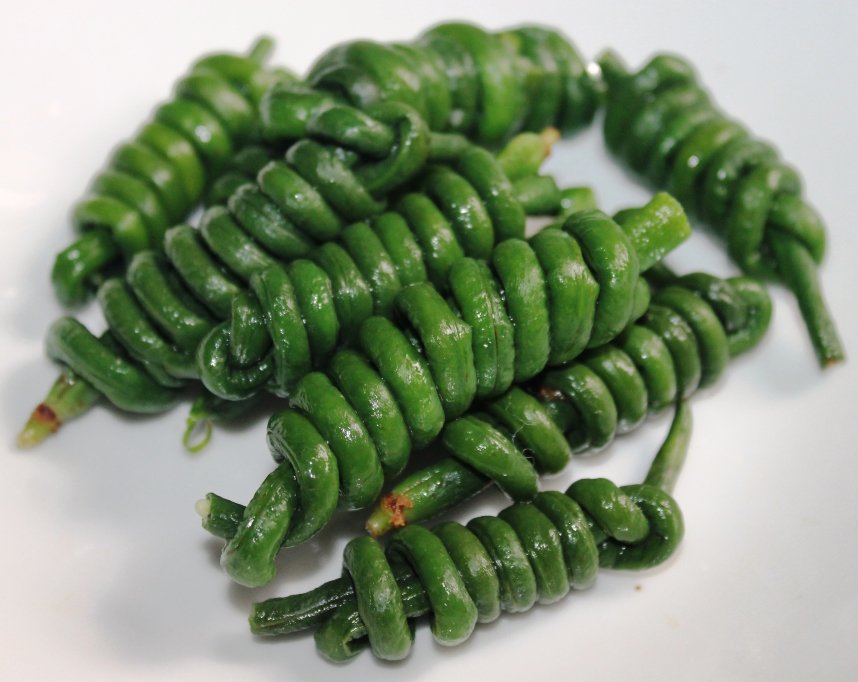
The true Corkscrew Vine (or Shell Vine - pictured), Cochliasanthus Vigna caracalla, is difficult to find but worth the effort. This vigorous and well-mannered garden plant produces very cool spiral flowers with an incredible scent that's reminiscent of Chinese wisteria and noticeable from 15 feet away. The intricate, curly flowers are produced for several months during the summer. Originally from South America and grown by Thomas Jefferson at Montecello, these are memorable plants. If you've seen one in a private or public garden, locked on the amazing scent and fanciful flowers, and always wanted one of your own, now you can make that happen.

> True Snail/Corkscrew Vine Cochliasanthus Vignacaracalla - Seeds found here


> Purple Snail Vine Phaseolus Giganteus adenanthus - Seeds found here

.
.

Digg this

Wednesday

Stunning Dainty Anemonopsis

One of the Japanese aristocrats. Dainty and rare.

Native to the Japanese island of Honshu, Anemonopsis is frost hardy to zones 5-9. This hard-to-find woodlander forms clumps of cimicifuga-like foliage topped with nodding, waxy lilac flowers in late summer.

It flowers in late summer, with slender stems held above the foliage carrying delicate flowers with outer lilac sepals and inner violet petals forming a cup. Although not a small plant, as the flowering stems can reach up to 2', still has a sort of airy, dainty appearance among the others woodlanders.

Anemonopsis is self-fertile and an isolated plant will set modest amounts of seed. If sown in containers and exposed to winter chilling, germination will occur the next spring. Anemonopsis seed retains its viability in storage to a reasonable degree. Anemonopsis can also be propagated by division.


Anemonopsis Seeds found here...

Digg this

Thursday

Ephedra Ma Huang Herb Ephedra Sinica

A new Challenge.

Ephedra sinica - Ma Huang, an evergreen perennial herb that grows in some parts of China, is valued for its healing and stimulating properties for at least 5000 years. Related to junipers, it produces small cones from March to April. Reaches a mature size of about 3' tall and wide. Survives best in full sun, can handle drought, reflected heat, and cold down to 0 degrees F. Fine landscape plant or for making tea. In ancient China it was used for its medicinal qualities. Asthma, fever and colds were treated with Ma Huang. Since isolation of Ma Huang from several Ma Huang species, in the early 1920s, Ma Huang became a popular drug for the treatment of asthma.

The Drug Ephedra itself (ephedrine alkaloids or active ephedrine alkaloids) appears to be monitored or banned in some states and countries, however botanical seeds and plants are not included. You can find more information here: 


Note: All legal information should be verified

Seeds found here...


Digg this

Monday

Tropical Sea Grape

The Sea Grape (Coccoloba uvifera), native to the sandy seashores of tropical America, usually forms a low shrub or small tree. The stiff, roundish leaves may measure 8 by 7 inches (20 by 17.5 cm) and have prominent veins. 
The attractive appearance of the leaves on the flexuous branches and the resistance of the plant to damage by salt make it valuable as an ornamental for ocean-side homes. 


Small white flowers are produced on slender, hanging racemes 4 to 10 inches long (10 to 25 cm). As many as 40 or 50 fruits may be found on a single cluster, giving the appearance of a bunch of grapes.

The velvety fruits are round to pear-shaped, about 3/4 of an inch long (2 cm), and range from dark purple, to purple, to occasionally off white. The edible pulp surrounds a globular seed with a short sharp point on the top. The pulp is sweetish-acid in flavor and is eaten out of hand or is used to make an excellent jelly.


The sea grape can be readily propagated by seeds and by cuttings of ripe wood. Excellent Houseplant and Bonsai material.


Digg this

Gourmet Melon Pear Pepino Dulce

If you can grow tomatoes, you can grow pepinos. The Pepino, also called the Melon Pear,is a rare and delicious fruit you're not likely to find in markets.

It's neither a melon nor a pear, but is related to tomatoes and eggplant. Pepino is a leafy, small bush or shrub with beautiful purple and white flowers, easy to grow in any zone free of frost. Perfect for patio containers and hanging baskets. 

 Pepino or Poire-melon is a species of evergreen shrub native to South America and grown for its sweet edible fruit. Put them in a salad or eat them for dessert.

The fruit is common in markets in Colombia, Ecuador, Bolivia, Peru and Chile, but less often overseas because it is quite sensitive to handling and does not travel well.

The fruit has been introduced into up-scale markets in Japan, Europe and North America and it is slowly becoming less obscure outside of South America. Moreover, in the United States the fruit is known to have been grown in San Diego before 1889 and in Santa Barbara by 1897.

Ideal for growing in the greenhouse or a sheltered sunny spot outdoors in a container, as the plants need warmth to flower and fruit successfully.

Seeds available here

.

Digg this

Orange Jewelweed Spooted Impatiens

Jewelweed (Impatiens capensis) is a hardy annual wildflower that grows in moist or wet area, often by lakes or streams. 

The tubular flowers are orange or yellow-orange speckled with red, the leaves are deep green. 

The long seed pods that appear after flowering will explode when touched, scattering the seeds. Plant in full sun to full shade in moist or wet humus rich soil. 

It will not grow well in dry soil. Seeds may be planted in spring or fall. Grows quickly. Self sows. Grows to a height of 1-5ft and will spread to 18 - 24 inches.
 

Jewelweed is often used in aiding the discomfort of poison ivy and insect bites. The juice present in the stems and leaves will alleviate the itching and rash of poison ivy in some people. 
Fresh leaves and stems may be crushed and applied to the area. The leaves and stems can also be simmered in a small amount of water and frozen for use at a later time.

Digg this

Wednesday

True Indigo Dye Plant

Indigofera tinctoria is the scientific name of true indigo, a plant best known as the source of the blue pigment used to dye denim.


The 3- to 6-foot-tall spreading growth habit bears pale gray-green foliage and pink flowers, making it appropriate for ornamental usage in USDA zones 5 to 9. True indigo is easy to grow from seeds, like all legumes when soil temperatures reach 70 degrees F.

Dye is obtained from the processing of the plant's leaves.
The leaves were soaked in water and fermented in order to convert the glycoside indican present in the plant to the blue dye indigotin. The precipitate from the fermented leaf solution was mixed with a strong base such as lye, pressed into cakes, dried, and powdered. The powder was then mixed with various other substances to produce different shades of blue and purple.

Historically, indigo was a natural dye extracted from plants, and this process was important economically because blue dyes were once rare. Nearly all indigo dye produced today — several thousand tons each year — is synthetic. It is the blue of blue jeans.

Digg this

Lollipop Vine

It's been raining a lot and the plants are thriving. I've discovered a new gem.

This rare ornamental collector Specimen vine has spectacular marble sized fruits. Also known as Marble Vine, Bryonia and Diplocyclos palmatus

Tropical, slender, much-branched climber, perennial, with stems to 6 m long. Leaves simple, alternate, 5 lobed, hairy above, pale and smooth beneath, margins irregularly toothed.
 

Flowers white to yellowish, unisexual, male flowers in small fascicles and females flowers solitary. It flowers from March to April. Fruit green with white longitudinal stripes, which become brightly red to orange with maturity.


Digg this

Say NO to GMO

Genetically modified organisms, or GMOs, are created when a gene from one species is transferred to another, creating something that would not be found in nature.
A large percentage of domestic crops (up to 94% of soybean yields) have DNA that was tweaked in a lab, yet it is nearly impossible to know which food items contain these genetically engineered ingredients. Thankfully new mobile phone apps are making it a bit easier for the consumer to know what she is eating, but this is not enough.
GMOs are bad for your body, bad for the community, bad for farmers and bad for the environment. This is why:
  1. The health consequences of eating genetically modified organisms are largely unknown. Genetically engineered foods have not been shown to be safe to eat and may have unpredictable consequences. When trans-fats were first introduced, corporations battled to get them onto your grocery shelves – and it is only decades later that this once novel food has been proven to be extremely unhealthful. Many scientists are worried that the genetically altered foods, once consumed, may pass on their mutant genes to bacterium in the digestive system, just like the canola plants on the roadsides of North Dakota. How these new strains of bacteria may affect our body systems’ balance is anybody’s guess.
  2. Food items that contain GMOs are unlabeled in America. Why so sneaky? The European Union has banned GMOs, as have Australia, Japan, the UK and two dozen other countries that recognize that a lack of long term studies and testing may be hiding disastrous health defects.
  3. Genetic engineering reduces genetic diversity. When genes are more diverse, they are more robust; this is why a pure bred dog tends to have greater health problems than the dear old mutt. Plants with reduced genetic diversity cannot handle drought, fungus invasions or insects nearly as well as natural plants, which could have dire consequences for farmers and communities dependent on GMO crops for survival.
  4. Once the mutant genes are out of the bag, there is no going back. Genetically modified organisms contaminate existing seeds with their altered material, passing on modified traits to non-target species. This creates a new strain of plant that was never intended in the laboratory. In North Dakota, recent studies show that 80% of wild canola plants tested contained at least one transgene. In Japan, a modified bacteria created a new amino acid not found in nature; it was used in protein drinks and before it was recalled it cause severe mental and metabolic damage to hundreds as well as several deaths. Japan banned GMOs after this horrific experience. Monarch butterflies have also died after their favorite food, milkweed, was cross-pollinated from Bt corn which rendered it toxic to the endangered species.
  5. GMOs are not the answer for global food security. Genetically engineered crops have shown no increase in yield and no decrease in pesticide use. In many cases other farm technology has proven much more successful, and even Monsanto agrees that its genetically engineered crops yield less than conventional farming.
  6. Genetically engineered foods have not been proven to be safe, but the few studies conducted don’t look so hot. The organs of rats who ate genetically modified potatoes showed signs of chronic wasting, and female rates fed a diet of herbicide-resistant soybeans gave birth to stunted and sterile pups.
  7. Big biotech firms have very sketchy track records, but then again what would you expect from organizations who want to patent the world’s food supply? These massive biotech companies have a history of toxic contamination, deceiving the public and suing small farmers when their patented seeds blew across the fence. Biotech firms sell sterile seeds to African farmers- meaning the seeds are only good for one season, because the plants that grow up will not be able to reproduce. Farmers must buy new seeds every year instead of growing from the previous year’s yield. GMOs are not the farmers’ friend.
  8. GMOs require massive amounts of pesticides, herbicides and fungicides. These things are poisons, and should not be eaten or allowed to run off into our water supply. But they are, every day, by companies who care far more about the bottom line than they do about your health, your environment or your children’s future.
  9. Common Ingredients Derived from GMO Risk Crops
    Amino Acids, Aspartame, Ascorbic Acid, Sodium Ascorbate, Vitamin C, Citric Acid, Sodium Citrate, Ethanol, Flavorings (“natural” and “artificial”), High-Fructose Corn Syrup, Hydrolyzed Vegetable Protein, Lactic Acid, Maltodextrins, Molasses, Monosodium Glutamate, Sucrose, Textured Vegetable Protein (TVP), Xanthan Gum, Vitamins, Yeast Products.
The bottom line is that genetically modified organisms have not been proven in any way to be safe, and most of the studies are actually leaning the other direction, which is why many of the world’s countries have banned these items whose DNA has been genetically engineered. In America, they aren’t even labeled, much less banned, so the majority of the populace has no idea that they are eating lab-created DNA on a daily basis.
You best defense is to purchase certified organic foodwhich cannot contain any GMOs, and to tell your friends and loved ones to do the same.

Digg this