Showing posts with label rare seeds. Show all posts

Tuesday

Nine Star Perennial Broccoli !!


What do we have here? Rare 18th century heirloom. Finally got my hands on some Nine Star Perennial Broccoli. Nearly impossible to find in the USA.
This hardy, over-wintering brassica is a splendid and useful plant, producing a largish, central, cauliflower-like white head each spring, surrounded by anything from 5 to 15 smaller white multi-heads. Tastes slightly stronger in flavor than cauliflower, more like a cross between cauliflower and broccoli. Cropping improves if unused heads are removed before they go to seed. Very vigorous, this plant should go on for years. Hardiness zone 6+. It’s very possible to harvest up to 50 sprouting florets from one plant per season. Requires very rich soil. Tastes like a mild cauliflower with a hint of broccoli – very delicious.
This  is so exciting! 

Found Here: Brassica oleracea botrytis aparagoides


perennial vegetable, 9 star broccoli, 9 star cauliflower, ninestar broccoli, ninestar cauliflower, ossi seeds, rare heirloom, ancient vegetable, medieval vegetable, 9 star perennial, nine star perennial, rare seeds

Digg this

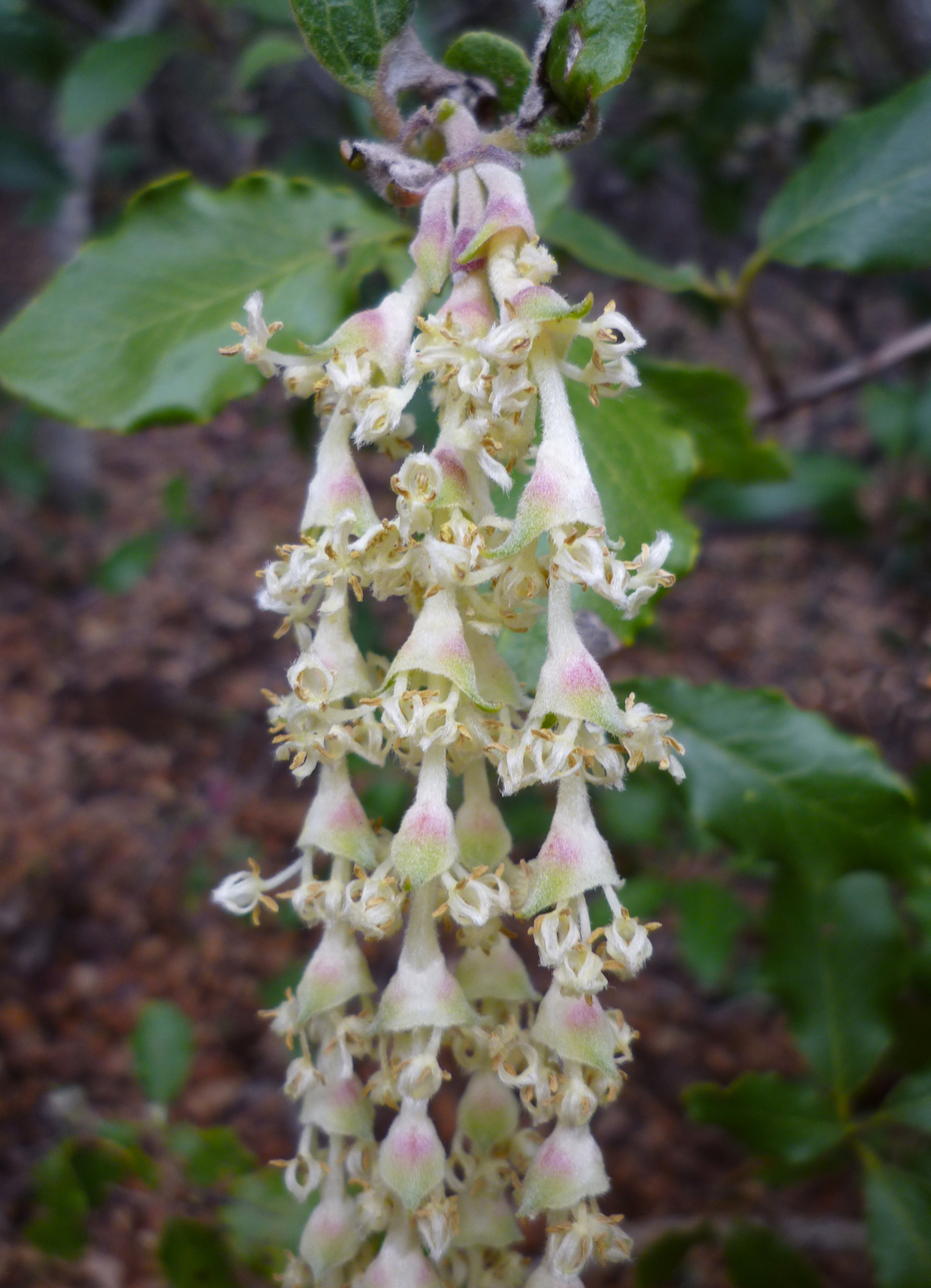
Droping and Weeping Showy Coast Silk Tassel Bush Garrya elliptica

 Garrya elliptica (Coast silk-tassel) is an evergreen shrub native to the coastal ranges of California and southern Oregon, south to Los Angeles County. It reaches a height of 7–15 ft.
Garrya elliptica is appealing as an ornamental plant with a neat growing habit. It is low-maintenance plant that thrives in a range of locations, but is typically seen growing against a wall, or as a windbreak in coastal areas.
It is very much sought after for its wavy, leathery leaves and luxuriant growth, and of course the pretty dangling whitish catkins. Produces purple berries, small (0.25 - 0.50 inches). Full sun to partial shade, zones 8 - 10.
This is a rare shrub with a long winded germination process; start seeds in late summer or fall.

Other Names: silk-tassel bush, wavyleaf silktassel, rare shrub, rare seeds, rare ornamental.


Digg this

Monday

Rare Chilean Nasturtium Tropaeolum tricolor


Tropaeolum tricolor, Soldadito is a winter growing plant found in Chile and Bolivia, with very delicate looking
shoots appearing usually around October. The shoots twine around any support and grow to a height of around 3 Ft.
As the leaves open they are a lovely fresh green and very fragile looking, unlike the common nasturtium.
It is however the flowers that are the main interest of the plant. As the specific name implies,
they have three colors being red and blackish violet with a yellow lip, a combination that sounds like a
miss-match but on these dainty flowers is very appealing.
The long-lasting flowers appear in generous profusion and always make me think of a school of tropical fish.

After flowering the plant then goes dormant for the summer. USDA Hardiness Zone 8.
The plant tolerates low temperatures 18F and can tolerate occasional snow cover for up to a couple of weeks per year. Excellent in a container.

Digg this

Friday

Rare Heirloom Giant White Choclo Corn from the Inca empire - Cuzco

Choclo, is a variety of corn, also referred to as Peruvian corn or Cuzco corn (named for the capital city of the Inca empire - Cuzco), is a large kernel corn from the Andes. It is consumed in parts of Central America and South America, especially in Peru, Bolivia and Colombia. Kernels are 1/2" inch and cobs grow to 8" inches.

Choclo is used in the making of humitas in Bolivia, choclo arepas (Corn Griddle Cakes) in Colombia and for pastel de choclo (Corn Pie). 


In Peru, choclo is commonly served as an accompaniment to dishes such as ceviche, and its toasted, salted form, similar to corn nuts, are customarily given free to restaurant patrons upon being seated. Full ears of choclo are also a popular street food in Peru and other Andean countries, typically served with a slice of cheese as choclo con queso. Finger foods like choclo con queso mirror the popularity of corn on the cob as a convenient street snack in Latin America.
I wonder if it makes giant popcorn as well :)

Seed Source: Choclo Perivuan Giant White Corn

Digg this

Monday

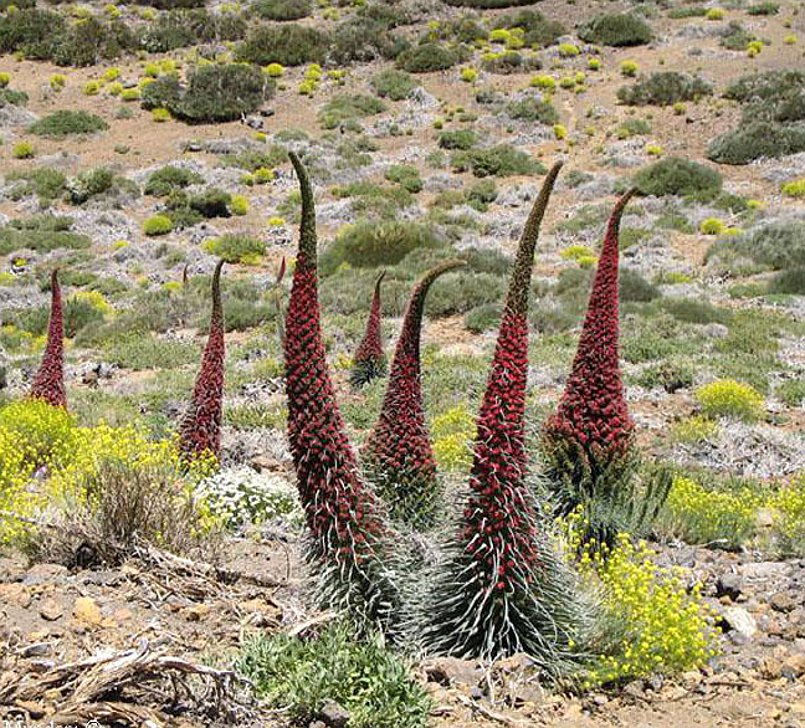
Tower of Jewels Tajinaste Rojo Echium wildpretii

One flower that is sure to make jaws drop is the Echium wildpretii of tower of jewels flower. The amazing biennial can grow from 5 to 8 feet tall and is coated in the second year with brilliant pink flowers. If sheer size doesn’t impress you, the silvery foliage and prominent anthers, give the flowers and foliage a sparkle when sunlight hits them.
This variety of Echium is native to the Canary Islands off the coast of Morocco. In this region the weather is mild with sunny warm sea breezes in summer and cool, but not freezing, winters. Echium tower of jewels starts its first year of life as a grayish to silver rosette set low to the ground and in the second year, it produces a tall, thick flower spire with slightly ragged silver foliage below. The spire bursts with cerise to salmon pink-cupped flowers arranged in rows upon rows. Each of the nearly one

hundred blooms has white anthers reaching out from the throat of the flower.
These catch the light and along with the foliage, making the plant appear to be dipped in pixie dust.
The Echium tower of jewels flower will give you years upon years of breathtaking beauty and architectural delight. Zones 8+. 


Seeds found here

Digg this

Friday

Chatter Flower Jovellana

What a cutie !!!!!

Jovellana does not have a common name. But it's been called Chatter Flower, Angels Goblet and Tea Cup Flower. It is a rare evergreen, perennial plant from Chile, that grows around 5 feet tall. Each flower spray has dozens of ½ inch blooms, which open at different times over a period of 1 to 2 months. The sprays would make an exotic addition to flower arrangements. Even without blooms this is an attractive plant, with woody stems and bright, mint-shaped foliage. The leaves have a great minty-spicy aroma when rubbed.

This is a cool-climate species that might not thrive in warm climates. The ideal temperature seems to be between 40 and 80 F. It is very rare in cultivation, and fresh seeds are rarely seen for sale. Great for Pot culture.


.

Digg this

Wednesday

Stunning Dainty Anemonopsis

One of the Japanese aristocrats. Dainty and rare.

Native to the Japanese island of Honshu, Anemonopsis is frost hardy to zones 5-9. This hard-to-find woodlander forms clumps of cimicifuga-like foliage topped with nodding, waxy lilac flowers in late summer.

It flowers in late summer, with slender stems held above the foliage carrying delicate flowers with outer lilac sepals and inner violet petals forming a cup. Although not a small plant, as the flowering stems can reach up to 2', still has a sort of airy, dainty appearance among the others woodlanders.

Anemonopsis is self-fertile and an isolated plant will set modest amounts of seed. If sown in containers and exposed to winter chilling, germination will occur the next spring. Anemonopsis seed retains its viability in storage to a reasonable degree. Anemonopsis can also be propagated by division.


Anemonopsis Seeds found here...

Digg this

Lollipop Vine

It's been raining a lot and the plants are thriving. I've discovered a new gem.

This rare ornamental collector Specimen vine has spectacular marble sized fruits. Also known as Marble Vine, Bryonia and Diplocyclos palmatus

Tropical, slender, much-branched climber, perennial, with stems to 6 m long. Leaves simple, alternate, 5 lobed, hairy above, pale and smooth beneath, margins irregularly toothed.
 

Flowers white to yellowish, unisexual, male flowers in small fascicles and females flowers solitary. It flowers from March to April. Fruit green with white longitudinal stripes, which become brightly red to orange with maturity.


Digg this

Sunday

Mediterranean Succulents

This stunning ground cover will grace my succulent patch in the spring. I am starting them from seed, so they will be ready for planting after the last frost (that is, if we get any)

Carpobrotus edulis is a perennial growing to 5 inches by 3 ft It is hardy to zone 8 and is frost tender. It is in flower from May to July, and the seeds ripen from Aug to September. The flowers are hermaphrodite (have both male and female organs) and are pollinated by Bees.
 

The plant prefers light (sandy) soils, requires well-drained soil and can grow in nutritionally poor soil.The plant prefers acid, neutral and basic (alkaline) soils. and can grow in saline soils.
 
It cannot grow in the shade.It requires dry or moist soil and can tolerate drought.The plant can tolerate maritime exposure.

Digg this

Wednesday

Blushing Bride Flower!

I am ready to grow my first Serruria from seed. Fresh seeds arrived and off  I go mixing soil according to instructions. This time it's required to sterilize the soil. How can you sterilize soil - There is the microwave method or you can pour boiling water over it several times.

This gorgeous South African member of the Proteaceae family reputedly derived its common name of “blushing bride” around 100 years ago when young men wore the flowers in their button holes when out courting in South Africa, the natural habitat to this lovely flower. 


The rare Serruria florida is a highly desirable small shrub which grows a 4 ft high and wide. The foliage is feathery and hairy.

Because of this ability to trap any available moisture, Serrurias are very tolerant of dry soil conditions.

To grow Serruria successfully, their main requirements are freedom from all but light frosts,full sun and perfectly drained soil.

Blushing Bride flowers in Spring producing soft, papery white bracts or floral leaves, surrounding feathery tufts of white to pinkish flowers. The blooms are either a white/creamy color with a delicate blush of pink, or an all-over rose pink color. They are in high demand for floral work, especially wedding bouquets and normally command a high price.


Blushing Bride Seeds

Digg this

Tuesday

Aussie Waratah Telopea speciosissima

The seeds I just purchased will be my second batch. Waratah seeds are incredibly easy to germinate, with a 100% germination rate, however I had a problem with the seedlings damping off last time. No seedling survivors. 

Now that I've learned a bit more about the Waratah seedlings need a slow climate adjustments, I am giving this another try.  - I demand success!!! ;)

This got to be one the most beautiful flowering shrubs I've ever seen! 


.

Digg this

Sturts Desert Pea Swainsona formosa

Another unusual, it never ends!!!

Clianthus formosus or Swainsona formosa Native Australian wildflower.
Incredibly beautiful plant with scarlet and black flowers reminiscent of exotic birds. Does best in dry conditions.


With dazzling crimson and black flowers having the ' appearance of a lobster claw, Clianthus will happily create a dense carpet of glaucous, ferny foliage from which these exciting flowers will appear. Easily grown, and surviving the poorest of soils and the sunniest of positions, just like in its homeland of Australia.


Seeds available here

Optimum Germination Temperature: 65-70F. Sowing Depth: ¼in. Sowing Time: April to May. Best sown where it is to flower, it prefers a warm, sunny, sheltered spot and very deeply dug, dry, sandy soil. Before sowing, soak the seed for 24 hours, then sow ¼in deep and protect from excess wet by placing a cloche or sheet of glass on 4 bricks over the area.
Sow in place, resents transplanting. Excellent specimens can be grown as conservatory plants. Half-hardy annual, 6-12" tall.

Digg this

Friday

It's Time for Some Color!!!


I just bought masses of seeds to get started on the spring. I am so ready!!!!!! Pink  is the first color of choice this time and off we go, planting our acquired seeds from the magnificent Pink Coral Vine

It's also called Queen's Wreath, Queen's Lace, Chain of Love, Chinese Love Vine

The Pink Coral Creeper is native to Tropical America. Not often seen, the rare coral creeper is a favorite for its showy flowers seen mostly in summer and fall. Makes a fabulous container plant in cooler areas.

Coral creeper climbs on tendrils and has interesting heart-shaped leaves. Plant in full sun in most any soil. Water to establish, prune to control. Best used to run up supports such as a tree or a trellis. According to the seller, it is a carefree plant to own.


Digg this

Tuesday

The Thailand Parrot Flower

Stumbled upon during research:
Impatiens psittacina Hook.f.
The Thailand Parrot Flower
Dork Nok Khaew
Flower Bird Parrot


These delicate parrot flowers simply hang there. Whichever angle you look at them from you’d still see pink parrots. They’re a rare phenomenon.


A balsam, Impatiens psittacina is a very rare impatiens species first discovered in 1899 by British officer A.H. Hildebrand in Shan States of upper Burma and identified to the botanical world in 1901 by botanist E.D. Hooker.
This plant raises only in a small part of north Thailand (near Chiang Mai), Burma, and one territory of eastern India. The species can be found in several botanical reference books including Plants of India.
Hooker originally stumbled upon the plant in India and brought back the seed to the Royal Botanic Garden Kew in London. Those seeds did not reproduce after the first year.


The parrot flower is one of nature's most beautiful creations. A rare plant and a protected species. The Thai government has elected to ban the export of seeds or plants because they are extremely rare. Punishment is severe for those who break this law.

Note: I have been seeing some questionable sellers from China offering these seeds. I am not sure what type if seeds they are selling (probably carrots), but they are definitely not Parrot Flower seeds!! 
It angers me that fraud china sellers are duping people into buying rainbow roses, black rose and some other non existing junk. Don't get duped! Do your research!

Digg this