Showing posts with label rare plant. Show all posts

Tuesday

Magnificent Tree Marigold Tithonia Tithonia diversifolia


Tithonia diversifolia, also known as Bolivian Sunflower, Tree Marigold and Mexican Sunflower is a wonderful perennial subtropical plant - resilient and adaptable, very showy and unusual, unbelievably fast growing, comes back every year. Zone 8-10. This species grows fast and large and needs plenty of space in the landscape. Plants can easily grow to 12 feet tall and wide in a single year. The bright yellow to orange, 6-inch diameter flowers can appear anytime there is active growth, but bloom production peaks in late summer and fall. There is a slight, pleasant fragrance, highly attractive to bees and butterflies. They need a full sun location for best flower production, but the plants will also tolerate some shade. Also suitable for container culture in colder climates if pruned regularly.
Tithonia diversifolia enriches the soil and can be used as a green fertilizer, it has the ability to restore phosphorus in high amounts to the soil. As a green fertilizer it contains N - 1.76% P - 0.82% K - 3.92%. It can also be used as chicken feed, fuelwood, soil erosion control, and building materials. For fertilization, it is used as a mulch which can be spread on top of the soil or buried beneath it.

Digg this

Monday

Iochroma fuchsioides Red Mini Angles Trumpet


This beautiful and rare and  perennial gem from South America is a relative of the Angel Trumpets (Brugmansia) with smaller leaves and more refined flowers. Lower-growing than other Iochromas, it forms a bushy, spreading plant that is often covered in clusters of fiery red, long tubular flowers that flare 5/6" wide at the tips. Iochroma fuchsioides is absolutely dazzling and breathtaking in full bloom! Hardy from zone 8 onwards. 4 feet tall and wide. Full sun to part shade. Average garden soil. Moderate water needs. Lovely! 


  • Seeds found here
  • Plants found here (none - please provide a source if you have one)

Digg this

Friday

Dioscorea elephantipes Elephant Foot Caudiciform

A fascinating plant. 

Dioscorea elephantipes (syn. Testudinaria elephantipes), also commonly known as turtle back, elephant's foot, Hottentots' bread is one of the most beautiful, weird and wonderful, caudiciform plants around!

It has a deeply fissured surface, resembling an elephant's foot, hence its common name. It makes a most interesting container plant. The stems grow in a climbing fashion. The leaves are heart-shaped. Flowers are pale greenish yellow and normally appear in winter.

It is believed the Khoisan used to bake the starchy, bread-like trunk which was used as a food source. Other members in the genus Dioscorea are used to extract steriodal saponins which are used to produce cortisone and and contraceptives.

Easily grown in any well drained inorganic soil. 


Seed Source: Dioscorea elephantipes

Digg this

Monday

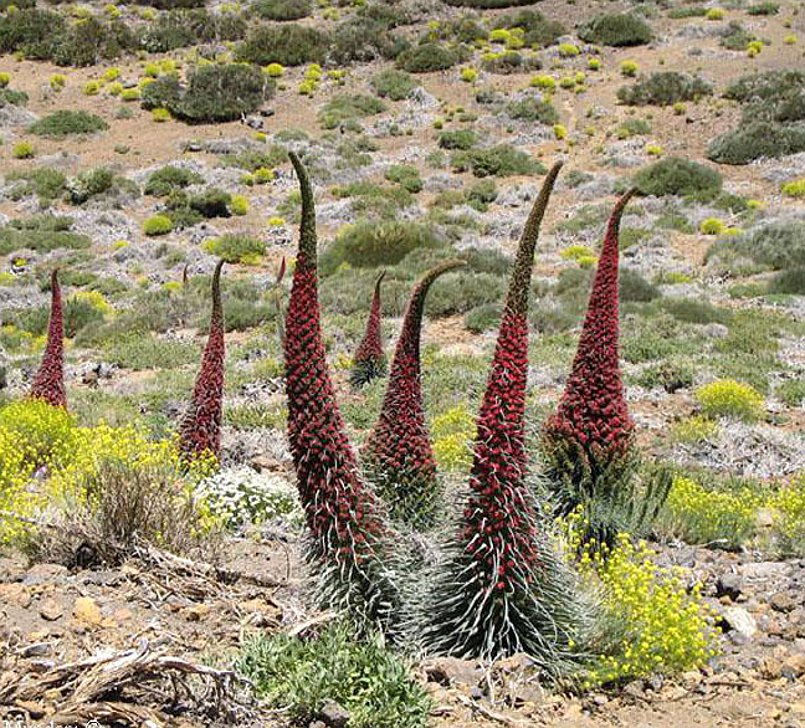
Tower of Jewels Tajinaste Rojo Echium wildpretii

One flower that is sure to make jaws drop is the Echium wildpretii of tower of jewels flower. The amazing biennial can grow from 5 to 8 feet tall and is coated in the second year with brilliant pink flowers. If sheer size doesn’t impress you, the silvery foliage and prominent anthers, give the flowers and foliage a sparkle when sunlight hits them.
This variety of Echium is native to the Canary Islands off the coast of Morocco. In this region the weather is mild with sunny warm sea breezes in summer and cool, but not freezing, winters. Echium tower of jewels starts its first year of life as a grayish to silver rosette set low to the ground and in the second year, it produces a tall, thick flower spire with slightly ragged silver foliage below. The spire bursts with cerise to salmon pink-cupped flowers arranged in rows upon rows. Each of the nearly one

hundred blooms has white anthers reaching out from the throat of the flower.
These catch the light and along with the foliage, making the plant appear to be dipped in pixie dust.
The Echium tower of jewels flower will give you years upon years of breathtaking beauty and architectural delight. Zones 8+. 


Seeds found here

Digg this

Thursday

Incredible Maniltoa


Latest stunning discovery.

The Australian Manitloa is a highly ornamental small tree with very spectacular, cascading pink new growth. As an added attraction to the spectacular new foliage growth it will produce fluffy white balls of flowers. It will grow into a medium size tree suitable for suburban back yards. 


They produce a brown pod containing one brown seed, probably one of the reasons why no one sells them.


Common names include: Silk Handkerchief Tree, Cascading Bean, Native Handkerchief Tree.


Digg this

Wednesday

Stunning Dainty Anemonopsis

One of the Japanese aristocrats. Dainty and rare.

Native to the Japanese island of Honshu, Anemonopsis is frost hardy to zones 5-9. This hard-to-find woodlander forms clumps of cimicifuga-like foliage topped with nodding, waxy lilac flowers in late summer.

It flowers in late summer, with slender stems held above the foliage carrying delicate flowers with outer lilac sepals and inner violet petals forming a cup. Although not a small plant, as the flowering stems can reach up to 2', still has a sort of airy, dainty appearance among the others woodlanders.

Anemonopsis is self-fertile and an isolated plant will set modest amounts of seed. If sown in containers and exposed to winter chilling, germination will occur the next spring. Anemonopsis seed retains its viability in storage to a reasonable degree. Anemonopsis can also be propagated by division.


Anemonopsis Seeds found here...

Digg this

Lollipop Vine

It's been raining a lot and the plants are thriving. I've discovered a new gem.

This rare ornamental collector Specimen vine has spectacular marble sized fruits. Also known as Marble Vine, Bryonia and Diplocyclos palmatus

Tropical, slender, much-branched climber, perennial, with stems to 6 m long. Leaves simple, alternate, 5 lobed, hairy above, pale and smooth beneath, margins irregularly toothed.
 

Flowers white to yellowish, unisexual, male flowers in small fascicles and females flowers solitary. It flowers from March to April. Fruit green with white longitudinal stripes, which become brightly red to orange with maturity.


Digg this