Showing posts with label rare vine. Show all posts

Monday

Rare Chilean Nasturtium Tropaeolum tricolor


Tropaeolum tricolor, Soldadito is a winter growing plant found in Chile and Bolivia, with very delicate looking
shoots appearing usually around October. The shoots twine around any support and grow to a height of around 3 Ft.
As the leaves open they are a lovely fresh green and very fragile looking, unlike the common nasturtium.
It is however the flowers that are the main interest of the plant. As the specific name implies,
they have three colors being red and blackish violet with a yellow lip, a combination that sounds like a
miss-match but on these dainty flowers is very appealing.
The long-lasting flowers appear in generous profusion and always make me think of a school of tropical fish.

After flowering the plant then goes dormant for the summer. USDA Hardiness Zone 8.
The plant tolerates low temperatures 18F and can tolerate occasional snow cover for up to a couple of weeks per year. Excellent in a container.

Digg this

Thursday

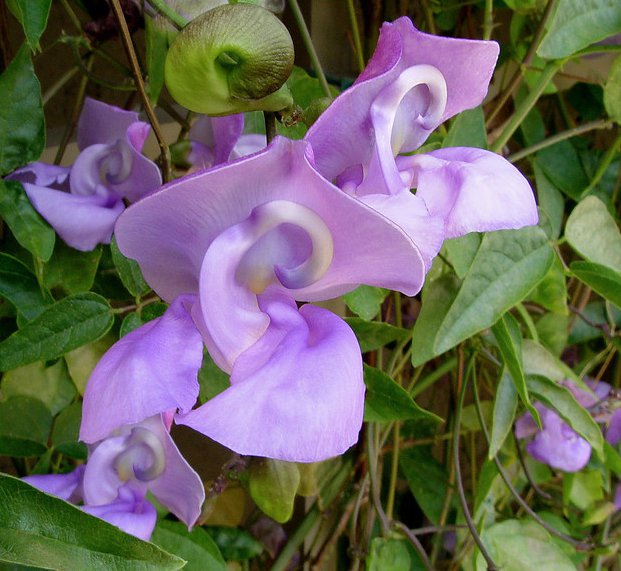
True Fragrant Corkscrew Shell Vine Cochliasanthus Vigna caracalla


Super cool Collector Vine the true Cochliasanthus Vigna caracalla! Definitely a to "drool" over Plant. Very hard to find.
Cochliasanthus caracalla is a leguminous vine from the family Fabaceae, originating in tropical South America and Central America. The species is named caracalla, a corruption of the Portuguese caracol, meaning snail.

The true Corkscrew Vine (or Shell Vine), Cochliasanthus Vigna caracalla, is difficult to find but worth the effort. This vigorous and well-mannered garden plant produces very cool spiral flowers with an incredible scent that's reminiscent of Chinese wisteria and noticeable from 15 feet away. The intricate, curly flowers are produced for several months during the summer. Originally from South America and grown by Thomas Jefferson at Montecello, these are memorable plants. If you've seen one in a private or public garden, locked on the amazing scent and fanciful flowers, and always wanted one of your own, now you can make that happen. 

  
There are two similar looking plants called Vigna caracalla.  Both produce pretty, spiral-form flowers in soft pastel shades. And the foliage of both is heart shaped, looking much like that of pole beans which makes sense because these are legumes and are therefore related to beans. In fact, both plants will produce slender, bean-like pods under good growing conditions.

------------------------------------------------------------------
The other awesome snail vine (this is not a Caracalla):

The Purple Snail Vine, Phaseolus giganteus, is a little more aggressive, sometimes invasive plant that tends to root where the branches touch the ground and can be difficult to eradicate.
The flowers of the Snail Vine lack the fragrance that represents a key reason gardeners choose to grow these plants. Snail vines are often erroneously sold and labeled as Vigna caracalla.


.

Digg this

Friday

Chatter Flower Jovellana

What a cutie !!!!!

Jovellana does not have a common name. But it's been called Chatter Flower, Angels Goblet and Tea Cup Flower. It is a rare evergreen, perennial plant from Chile, that grows around 5 feet tall. Each flower spray has dozens of ½ inch blooms, which open at different times over a period of 1 to 2 months. The sprays would make an exotic addition to flower arrangements. Even without blooms this is an attractive plant, with woody stems and bright, mint-shaped foliage. The leaves have a great minty-spicy aroma when rubbed.

This is a cool-climate species that might not thrive in warm climates. The ideal temperature seems to be between 40 and 80 F. It is very rare in cultivation, and fresh seeds are rarely seen for sale. Great for Pot culture.


.

Digg this

Wednesday

Lollipop Vine

It's been raining a lot and the plants are thriving. I've discovered a new gem.

This rare ornamental collector Specimen vine has spectacular marble sized fruits. Also known as Marble Vine, Bryonia and Diplocyclos palmatus

Tropical, slender, much-branched climber, perennial, with stems to 6 m long. Leaves simple, alternate, 5 lobed, hairy above, pale and smooth beneath, margins irregularly toothed.
 

Flowers white to yellowish, unisexual, male flowers in small fascicles and females flowers solitary. It flowers from March to April. Fruit green with white longitudinal stripes, which become brightly red to orange with maturity.


Digg this

Tuesday

Brazilian Dutchman's Pipe Aristolochia gigantea

Oh wow! Is this one is Bizarre!

Also known as Giant Pelican Flower, Aristolochia gigantea is a robust, twisting climber that can grow around a sturdy arbor or a tree up to 30 feet tall or higher.

This vine has fleshy heart-shaped leaves and large flowers exceeding a foot long and at least 6 inches wide. The flower is astounding, impressive, strange and sinister at the same time. The mouth of the pipe-shaped flower expands to a huge size and is colored with a maroon and white netting effect. In the “mouth” there is a central yellow spot where an opening leads into a closed pouch. The back view of the flower superficially resembles a pair of lungs with a canal leading into a stomach-like pouch. The blossom is over 14 inches (36 cm) long.
These huge, lemony scented flowers bloom from summer until late winter and are a sight to behold

Aristolochia gigantea usually grows in tropical regions from Panama to Brazil but it is incredibly hardy, and is an evergreen that will not die off at the first sign of a frost.


Seeds found here: Aristolochia gigantea

Digg this