Showing posts with label unusual plant. Show all posts

Saturday

Water Caltrop Bat Nut or Ling Nut Wicked Looking Aquatic Food

Happy Halloween! How about that! This in an interesting aquatic food that grows well in a container. 

The Ling Nut, Trapa bicormis, is a floating aquatic plant that grows best in slow moving or stagnant water, such as a pond, container or aquarium. It develops corms that are cooked, the interior eaten plain, fried or made in to butters and dips (similar to humus) for consumption. 

Very nutritious containing high amounts of fiber, potassium, magnesium, copper, vitamin B6 and riboflavin. Most of their calories come from carbs. Leaves, shells and nuts have also medicinal properties.

Submerged stem are anchored into the mud by very fine roots. It has two types of leaves, finely divided feather-like submerged leaves borne along the length of the stem, and undivided floating leaves borne in a rosette at the water's surface. 

 The plant can become invasive in some areas, a large container is recommended. Needs at least 6 months of frost free growing time.

Excess nuts can be dried are highly sought after and used for crafting for amulets, key ring adornment, ornaments and many other crafts.


Viable corms (USA):  Found here

 
Rare plant, rare aquatic, aquatic edible, water chestnut, Buffalo Nut, Bull Nut, Devil's Pod, Horn nut, Lucky Nut, Goat Head, Bat Nut, Ling Kok, Kacang Tanduk, Ling kio, Singhada, aquarium seeds, aquarium plant, unusual plant, edible shtf, wild food, pond food.


Digg this

Thursday

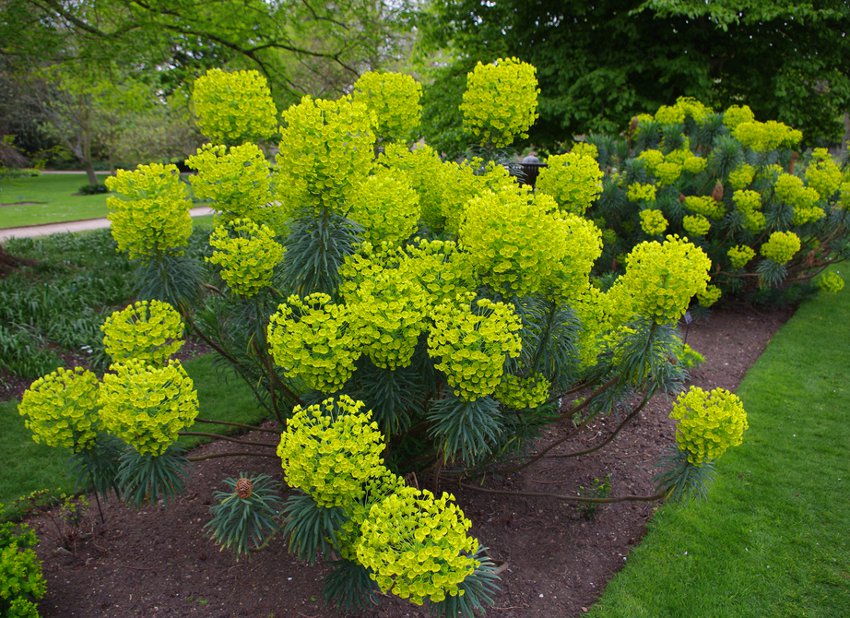
Mediterranean Spurge

The whole plant grows 3-5’ feet tall and wide, making it a perfect focal point for a spot with well-drained soil and full sun. The milky sap may cause irritation to skin and eyes. Do not eat! USDA Zones 7 to 10.Seeds Euphorbia characias subsp. wulfenii is a dramatic perennial plant that grows into a large robust plant. 

In late winter to early spring great club-like inflorescences emerge from the crown. Bright chartreuse flower-like bracts glow in the garden of particularly large flowers with an intense color. 

The overall effect is eye-catching and lasts well into June. At about the same time, new shoots emerge holding narrow, grey-green leaves.

Digg this

Friday

Dioscorea elephantipes Elephant Foot Caudiciform

A fascinating plant. 

Dioscorea elephantipes (syn. Testudinaria elephantipes), also commonly known as turtle back, elephant's foot, Hottentots' bread is one of the most beautiful, weird and wonderful, caudiciform plants around!

It has a deeply fissured surface, resembling an elephant's foot, hence its common name. It makes a most interesting container plant. The stems grow in a climbing fashion. The leaves are heart-shaped. Flowers are pale greenish yellow and normally appear in winter.

It is believed the Khoisan used to bake the starchy, bread-like trunk which was used as a food source. Other members in the genus Dioscorea are used to extract steriodal saponins which are used to produce cortisone and and contraceptives.

Easily grown in any well drained inorganic soil. 


Seed Source: Dioscorea elephantipes

Digg this

Wednesday

Unusual Ceropegia

Another unusual beauty I am contemplating on growing - well, that if I can locate it. This might even be growing in my area. What a perfect little gift this would make!

Ceropegia ampliata - Bushman's Pipe

C
eropegia ampliata is from southern Africa; it’s called horny wonder or bushman’s pipe. Nearly leafless rambling stems produce 3-inch inflated balloon like flowers. The thick, twining, succulent stems make this plant well-suited to hanging basket culture or trellising. This plant needs at least 4 hours of direct sunlight per day and can withstand a fair amount of drought.


There are several varieties it seems, one pictured below...


Ceropegia sa
ndersonii - Parachute plant, Umbrella Plant

Umbrella plant is also from southern Africa and belongs to the family Asclepiadaceae, and so is it closely related to the milkweed varieties that are grown as butterfly plants in gardens throughout the United States. It likes full, but not hot, sun and the potting medium should be kept moderately moist during the growing period. It doesn’t like wet feet, so allow it to dry slightly between watering. It is extremely sensitive to Malathion.

Digg this