Showing posts with label rare flower. Show all posts

Monday

Rare Chilean Nasturtium Tropaeolum tricolor


Tropaeolum tricolor, Soldadito is a winter growing plant found in Chile and Bolivia, with very delicate looking
shoots appearing usually around October. The shoots twine around any support and grow to a height of around 3 Ft.
As the leaves open they are a lovely fresh green and very fragile looking, unlike the common nasturtium.
It is however the flowers that are the main interest of the plant. As the specific name implies,
they have three colors being red and blackish violet with a yellow lip, a combination that sounds like a
miss-match but on these dainty flowers is very appealing.
The long-lasting flowers appear in generous profusion and always make me think of a school of tropical fish.

After flowering the plant then goes dormant for the summer. USDA Hardiness Zone 8.
The plant tolerates low temperatures 18F and can tolerate occasional snow cover for up to a couple of weeks per year. Excellent in a container.

Digg this

Friday

Rare Calico Monkey Flower Mimulus pictus


A truly rare gem. Calico Monkey Flower Mimulus pictus

This wildflower is endemic to California, found only above the southeastern San Joaquin Valley within Kern County and Tulare County.

It is known only from the western Tehachapi Mountains and southernmost Sierra Nevada foothills, at elevations of 443–4,101 ft.  It grows in open California oak woodland habitat, in bare rocky soils around granite outcrops.

Nothing like any Mimulus you have ever seen. A very rare and unusual plant with creamy-white rounded petals delicately patterned with fine dark-red to purplish brown spider web-like lines. Foliage is velvet fuzzy textured. Loves a well drained but moist soil in light shade. Zone 8+. Low growing about 6" to 12" in well drained, moist soil, sun or part shade.

It is a listed Endangered species on the California Native Plant Society Inventory of Rare and Endangered Plants.

Seeds available here:

Digg this

Monday

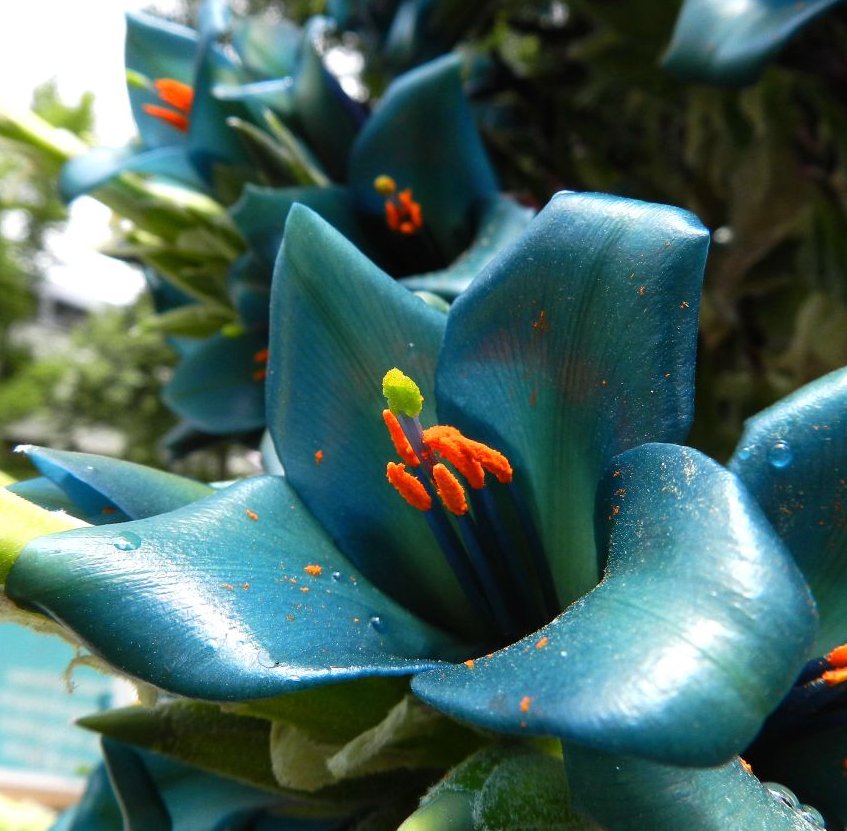
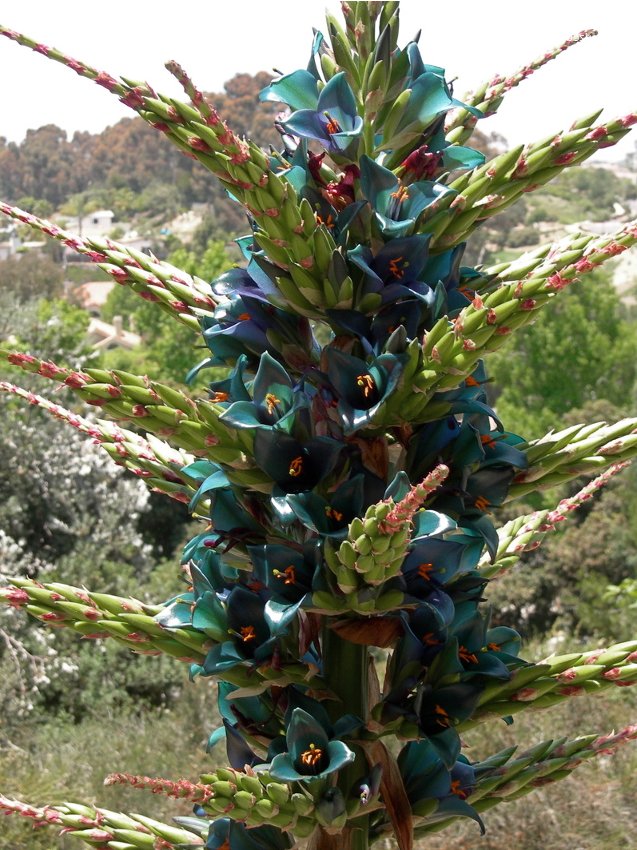
Puya alpestris Turquoise Metallic Flowers

Wow!  The plant kingdom at its flamboyant best. 

The highly ornamental Sapphire Tower is a hardy bromeliad relative native to regions of Argentina and Southern Chile along the slopes of the Andes Mountain Range.
It grows in areas with relatively dry and well drained soils with plenty of sunlight and does not require a lot of water.


It produces 2-3 foot wide rosettes of marginal-spined leaves that are silver-gray and striped beneath. 

When mature, the 4-5 foot tall, thick branching spikes produce long-blooming flowers that are neither sapphire blue nor sapphire green; they are an intense combination of the two colors. Bright orange stamens provide a lively contrast. A truly unique and incredible flower color. Blooms faster than the related Puya berteroniana.
In South America, the fleshy hearts of Puya flowers are frequently shredded, similar to cabbage in coleslaw and eaten in salads.
This plant makes a good specimen accent in a dry garden. It also works well in containers. Zones 8-11. 


Seeds found here:  Puya 30 Seeds for sale

Plants found here:  Puya Plants for sale

Digg this

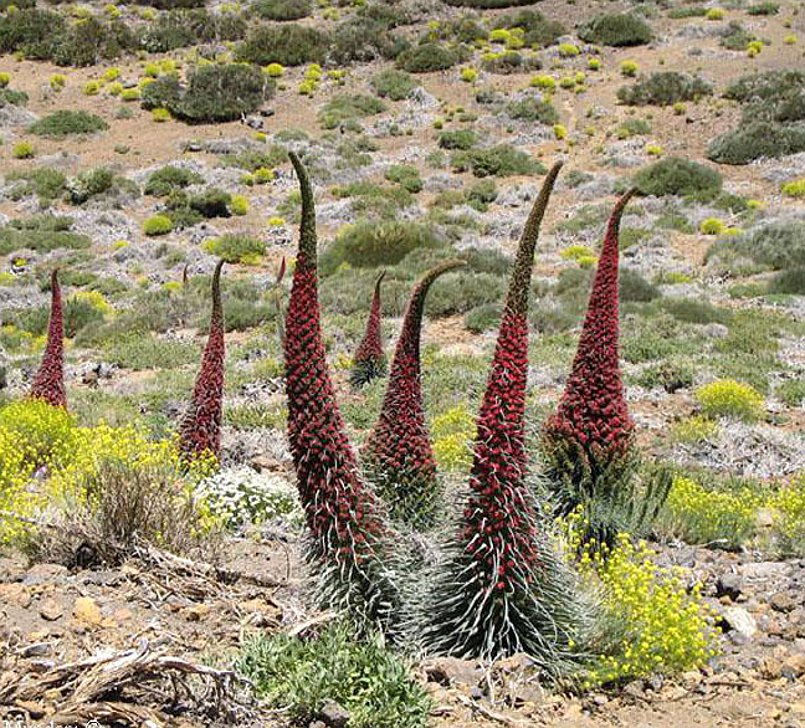
Tower of Jewels Tajinaste Rojo Echium wildpretii

One flower that is sure to make jaws drop is the Echium wildpretii of tower of jewels flower. The amazing biennial can grow from 5 to 8 feet tall and is coated in the second year with brilliant pink flowers. If sheer size doesn’t impress you, the silvery foliage and prominent anthers, give the flowers and foliage a sparkle when sunlight hits them.
This variety of Echium is native to the Canary Islands off the coast of Morocco. In this region the weather is mild with sunny warm sea breezes in summer and cool, but not freezing, winters. Echium tower of jewels starts its first year of life as a grayish to silver rosette set low to the ground and in the second year, it produces a tall, thick flower spire with slightly ragged silver foliage below. The spire bursts with cerise to salmon pink-cupped flowers arranged in rows upon rows. Each of the nearly one

hundred blooms has white anthers reaching out from the throat of the flower.
These catch the light and along with the foliage, making the plant appear to be dipped in pixie dust.
The Echium tower of jewels flower will give you years upon years of breathtaking beauty and architectural delight. Zones 8+. 


Seeds found here

Digg this

Friday

Chatter Flower Jovellana

What a cutie !!!!!

Jovellana does not have a common name. But it's been called Chatter Flower, Angels Goblet and Tea Cup Flower. It is a rare evergreen, perennial plant from Chile, that grows around 5 feet tall. Each flower spray has dozens of ½ inch blooms, which open at different times over a period of 1 to 2 months. The sprays would make an exotic addition to flower arrangements. Even without blooms this is an attractive plant, with woody stems and bright, mint-shaped foliage. The leaves have a great minty-spicy aroma when rubbed.

This is a cool-climate species that might not thrive in warm climates. The ideal temperature seems to be between 40 and 80 F. It is very rare in cultivation, and fresh seeds are rarely seen for sale. Great for Pot culture.


.

Digg this

Wednesday

Stunning Dainty Anemonopsis

One of the Japanese aristocrats. Dainty and rare.

Native to the Japanese island of Honshu, Anemonopsis is frost hardy to zones 5-9. This hard-to-find woodlander forms clumps of cimicifuga-like foliage topped with nodding, waxy lilac flowers in late summer.

It flowers in late summer, with slender stems held above the foliage carrying delicate flowers with outer lilac sepals and inner violet petals forming a cup. Although not a small plant, as the flowering stems can reach up to 2', still has a sort of airy, dainty appearance among the others woodlanders.

Anemonopsis is self-fertile and an isolated plant will set modest amounts of seed. If sown in containers and exposed to winter chilling, germination will occur the next spring. Anemonopsis seed retains its viability in storage to a reasonable degree. Anemonopsis can also be propagated by division.


Anemonopsis Seeds found here...

Digg this

Blushing Bride Flower!

I am ready to grow my first Serruria from seed. Fresh seeds arrived and off  I go mixing soil according to instructions. This time it's required to sterilize the soil. How can you sterilize soil - There is the microwave method or you can pour boiling water over it several times.

This gorgeous South African member of the Proteaceae family reputedly derived its common name of “blushing bride” around 100 years ago when young men wore the flowers in their button holes when out courting in South Africa, the natural habitat to this lovely flower. 


The rare Serruria florida is a highly desirable small shrub which grows a 4 ft high and wide. The foliage is feathery and hairy.

Because of this ability to trap any available moisture, Serrurias are very tolerant of dry soil conditions.

To grow Serruria successfully, their main requirements are freedom from all but light frosts,full sun and perfectly drained soil.

Blushing Bride flowers in Spring producing soft, papery white bracts or floral leaves, surrounding feathery tufts of white to pinkish flowers. The blooms are either a white/creamy color with a delicate blush of pink, or an all-over rose pink color. They are in high demand for floral work, especially wedding bouquets and normally command a high price.


Blushing Bride Seeds

Digg this

Saturday

Devils Hand Tree

This weekend we are growing Chiranthodendron pentadactylon from seeds. My favorite seed supplier got some in, we're plenty stocked up and off we go. Suppose to be really easy, but given the availability this has yet to be seen, but I am confident!!

The seed trays are ready and so is the green house. Will update as we go along.


Available here

Digg this