Saturday

Another Fabulous Tropical Fruit

An Asian friend of mine introduced me to this incredible fruit, so I had to just run and get one.
It's distinctive flavor is melt-in-your-mouth. I was so excited that I planted some of the seeds and after just 2 weeks we had babies. Jackfruit is propagated by seed. Lets see if they will survive!! Wish me luck!

 
Common Name: Jackfruit
Scientific Name: Artocarpus heterophyllus
Family: Moraceae
Jackfruit tree is native to Southeast Asian Countries, but has found it way to other countries like Jamaica, Trinidad and Tobago and others. Jackfruit is a large prickly fruit similar in Durian fruit, it measures 12 to 20 inches long, 8 to 10 inches in width, and weigh about 18 kg. and more. 


Jackfruit are very fragrant, when you open the fruit you will find the fleshly bright yellow part (when ripe) which can be eaten raw or can be cooked with syrup. When unripe its flesh is green, and it can be made into a delicious vegetable dish. Inside the fleshy part are the seeds (nut) which is similar to chestnuts. Jackfruit seeds can be roasted or boiled.

Digg this

Tuesday

Piel De Sapo Christmas Melons

It's getting hot here!! Hope this helps all of us :)


Melon Margarita

Ingredients:
1.5 cup melon puree (see below) Best are Piel de Sapo melon, honeydew or watermelon.
1/2 cup tequila
3 tbsp orange liqueur (I used triple sec)
1/4 cup lime juice
3 tbsp sugar syrup or just sugar to taste
Ice
Coarse salt for the glass rim


Method:
To make the melon puree, remove the skin and seeds of a fresh melon and cut into large chunks. Place in a blender and process until smooth.
Wet the rim of the margarita glass with a piece of lime and dip in coarse salt in a shallow dish to coat the edge of the glass.
Combine all the ingredients along with ice in a cocktail shaker or blender and mix well.
Strain into the prepared Margarita glass, garnish with a lime wedge.

-------------------------------


Piel De Sapo Melon:
The shiney, green, blotched skin fits the literal translation of its name perfectly — "toad skin." But whats in a name. Their flesh is pale green to white and it is very tender, juicy and sweet. Super gourmet melon.
The fruits are oblong, eight to twelve inches long and average about eight pounds, with a shelf life of several months. Relatively rare, the variety originated in La Mancha, Spain.

Digg this

Saturday

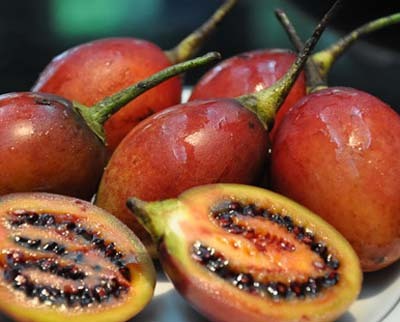
Tree Tomato !!


Tamarillo also known as the Tree tomato is an exotic edible fruit that is native to the tropical parts of South America. The word tamarillo is believed to come from several languages "tomato", the Spanish word "amarillo", meaning yellow, and a variation on the Maori word "tama", meaning "leadership". It is an egg shaped fruit that is pointed at both ends and may be red, purple, amber, or golden yellow in color. The flesh is tangy and tart, but flavorful.       
Tamarillos contain lots of potassium as well as 40mg of vitamin C per 100 grams, which makes them excellent source of Vitamin C.

Tamarillos can be eaten raw or used as the fresh fruit in all basic fruit recipes from cheesecakes to apple crumble, from ice cream and sherbets to fruit sauces, chutneys, jams, jellies, and pickles. Sliced on pizzas, toast and in sandwiches or added to casseroles and even lightly fried as a steak accompaniment.


------------------
Tamarillo Chutney
30-50 tamarillos, cleaned and trimmed,
1kg brown sugar,
1 cup malt vinegar,
4 cloves garlic,
4 Granny Smiths,
3 brown onions,
cayenne pepper,
salt and freshly cracked black pepper
Soak tams in a boiling water, then peel (when the water is quite safe for your hands). Put them in the food processor and blend until smooth. Pour into a large saucepan. Chopped the brown onions and apples in large chunks and process them in the food processor until smooth. Pour into the saucepan. Mix all the rest of ingredients, stir well and cook in a medium heat until bubbly and thicken. Correct the seasoning. Pour into hot sterilized jars and seal.  
Makes 11-13 various jars.

Digg this

Tuesday

Vertical Gardens

Lately I've been getting fascinated by vertical gardens and discovered during research the artist Partick Blanc. This is a direct quote from the wikipedia:


Patrick Blanc (born June 3, 1953 in Paris) is a botanist, working at the French National Centre for Scientific Research, where he specializes in plants from subtropical forests. He invented the concept of a vertical garden:


“ On a load-bearing wall or structure is placed a metal frame that supports a PVC plate 10 millimetres (0.39 in) thick, on which are stapled two layers of polyamide felt each 3 millimetres (0.12 in) thick. These layers mimic cliff-growing mosses and are support the roots of many plants. A network of pipes controlled by valves provides a nutrient solution containing dissolved minerals needed for plant growth. The felt is soaked by capillary action with this nutrient solution, which flows down the wall by gravity. The roots of the plants take up the nutrients they need, and excess water is collected at the bottom of the wall by a gutter before being re-injected into the network of pipes: the system works in a closed circuit. Plants are chosen for their ability to grow on this type of environment and depending on available light.”


Amazing how Patrick grew this organic wallpaper inside a private home. I don't quite have the courage and confidence to start one because I know way too little about it. But this stuff is great enough to be posted and shown off on my humble blog :)

Digg this

Wednesday

Drooling over Hibiscus schizopetalus

This striking flower is an original species of Hibiscus. It is frequently used as a parent in the modern hybrids. It forms an arching shrub or small tree and produces flowers throughout the summer.

Hibiscus schizopetalus is a weeping tree hibiscus from Tropical E Africa . Grows rapidly and blooms freely. Hanging pink or red/coral colored flowers have 21/2 inch petals that curve up, with many deep lacy lobes, giving a beautiful effect. This fast growing shrub reaches 6-8 feet with a spread of 5-6 feet. Flowers sporadically year-round in greenhouse or in tropics, or during warm season elsewhere.


Can be grown as hanging basket plants and treated as an annual.


Grow in part shade and intermediate to warm temperatures. 2 parts peat moss to 2 parts loam to 1 part sand or perlite has been a successful potting medium. Do not allow to dry out, keep plant moist at all times. Give a monthly balanced fertilizer at ½ the strength recommended on the label.

Prune often to keep a desired form. Pruning often to give and keep shape, as well as encourage blooms which form on new wood.

Digg this

Tuesday

Canarina - Canary Bell Flower Canarina canariensis


Canary Bellflower is a beautiful herbaceous climbing perennial with bluish green leaves, slightly succulent stems and a tuberous root. Makes showy, large bell shaped bright orange to orange red pendulous flowers followed by astonishingly large, edible (!), walnut sized, bright orange yellow fruits. Keep dry as soon as plants go dormant at higher temperatures in summer. Start to water again as soon as new growth appears in autumn. Requires a climbing aid and is mainly winter-growing.

Canarina canariensis (Canary Bellflower)- a winter grower.


Digg this

Saturday

Bhut Jolokia World's Hottest chili pepper


Bhut Jolokia, a variety of chile pepper originating in Assam, India, has earned Guiness World Records' recognition as the world's hottest chile pepper by blasting past the previous champion Red Savina.

In replicated tests of Scoville heat units (SHUs), Bhut Jolokia reached one million SHUs, almost double the SHUs of Red Savina, which measured a mere 577,000.

Very challenging to grow. Requires relatively high temperatures to germinate and has a long growing period, so, for warm climates or conservatories only

Digg this

Garlic or Amethyst Vine

What stunning specimen. After the freeze here on the gulf coast seems to ravish most of my tropical's I was unable to cover, we'll start anew with a Garlic vine. All parts of the vine, when rubbed or crushed will smell like garlic and can be used in food.

Latin: Mansoa alliacea (Pseudocalymma alliaceum)
Family: Bignoniaceae
English: Garlic Vine
 

The vines of the Garlic Vine attach itself with strong twining tendrils. The leaves are bright green and up to 15 cm long. The flowers are first beautiful deep lavender and have a white throat. Later the flowers fade to a pale lavender and finally become almost white. All three flower colors can be found on the plant simultaneously.
Abundant bloom finds place two or more times during the rainy season. In other months incidental clusters of flowers appear. The flowers are regularly visited by hummingbirds looking for nectar.

Digg this

Wednesday

Figs - The Food of the Gods


Our precious Fig tree was ravished by the hard freeze a couple months ago. I had such great hopes, but ended up with shriveled up rotten fruits. How did that happen? Come to find out that figs soaked in rain water, frozen and exposed to heavy freezing winds are just dammed to die. 

If it doesn't come back we must start again with a hardier variety. 
A few months ago I received a couple of bags of fig fruits from my sister in law Catherine. They were super ripe and because I had no way of using them right away, they went in the freezer.
In fact, Figs freeze super well and will, this year, be used to make a fine jam, maybe even a fig/pear jam. After long research I've obtained a recipe that looked simple enough and sounded absolutely delicious. Simplicity and quality in home made foods is essential to me. 4 ingredients or less are preferred, but hey, I will get "helpers" too if it's more than 6 pounds

Here is the recipe: 
FIG JAM
6 qt. boiling water
6 qt. fresh figs
1/2 cup sugar for each cup of crushed figs
1 qt. water
8 slices lemon
Pour boiling water over figs; let stand 15 minutes. Drain and thoroughly rinse in cold water. Pat dry; remove stems Crush and measure figs, place in a large Dutch oven. Add 1/2 cup sugar for each cup of crushed figs. Add 1 quart water. Bring to a rapid boil, reduce heat and simmer, uncovered, 3 hours or until thickened, stirring occasionally.
Ladle jam into hot sterilized jars, leaving 1/4 inch head space. Add a slice of lemon to each jar. Cover at once with metal lids and screw on bands. Process in a boiling water bath for 10 minutes. Yields 8 1/2 pints.

Digg this

Saturday

A Blue Brugmansia?

I found this rare flower at my favorite seed shop. Looks like a Brugmansia Angel Trumpet and found it research worthy. It's actually a relative of the Brugmansia. This beauty comes from from South America:

Description: Small shrub, generally to 3-6ft, sometimes to 10ft. Flowers are borne in clusters of up to 6-12 and sometimes more. Flowers grow to about 2-3", are cobalt blue in color and can remain on the branches for a while. Flowering may occur for much of the warmer months. There is a white type as well.

Hardiness: Hardy to 20-22F. Growing Environment: Grows best in filtered sun to full sun. Water moderately.
Propagation: By seeds.

Uses: Still a rare plant, it is cultivated as an ornamental and can be found in a few botanical gardens. Native Range: Native to Argentina.


  Seeds of some varieties found here: Iochroma Seeds

Digg this

Friday

What is this?


Anyone? I can't locate any usable info at all on this plant! It was called "Beard Dianthus" and had no botanical name - that doesn't seem to fit. Please post if you know. Thanks much!!

Digg this

Beautiful Spoon Daisy

What an unusual species and, of course, nowhere to be found for purchase. It appears that this plant is patented and very much restricted to whole sale nurseries only.

The African Daisy, Osteospermum ecklonis Nasinga, or also called Scape Daisy, is a wonderful early spring and fall plant. This low maintenance variety is perfect for hanging baskets, combination's, window boxes and landscapes.

Plant Facts:
Mature Height: 8 - 14 inches
Mature Spread: 12 - 14 inches
Soil Type: Widely Adaptable
Moisture: Moderate
Mature Form: Mounding
Growth Rate: Moderate
Sun Exposure: Full Sun - Partial Sun
Flower Color: Lavender, Blue
Zones: 10-11

Digg this

Cool Cactus Blooms!!

Our cactus that we have had for only one year bloomed last fall, but just for one day, actually just a few hours. The cactus stands 5 ft tall when 3 bloom buds appeared out of nowhere. When it opened the bloom stem was about 6” long and the bloom 6” across. I had get up at 5 AM to take pictures. The bloom closed by 9:00am that morning never to open again. We never dreamed that the bloom for as large as it is would only be open for a few hours.

Notes:
San Pedro Cactus, Trichocereus pachanoi, is native to several places in South America. San Pedro Cactus is found in Southern Ecuador at the Chanchan valley ranging from 6,600-9,000 feet. In Peru, in the Huancabamba valley and in Quebrada Santa Cruz at 10,800 ft. San Pedro Cactus grows naturally in these locales, San Pedro Cactus is cultivated all over Peru and in other places in South America.

San Pedro Cactus cuttings are fast growing (12-18" per year) if grown in warm, moist and rain-rich areas. If San Pedro Cactus cuttings are grown indoors they should be kept in a warm area of your house, direct sunlight is important for San Pedro Cactus cuttings to flourish in-doors. Watering San Pedro Cactus cuttings should be done daily, doing so you can almost watch your San Pedro Cactus cutting growing. San Pedro Cactus is a very hardy cactus, it grows quickly when watered daily but will survive long periods without water. San Pedro Cactus cuttings can survive for months or even years and can develop lateral shoots even without food or water.The almost spineless columnar San Pedro Cactus can grow as tall as 19 ft. San Pedro Cactus has several ribs, usually six but often seven or eight, sometimes as many as twelve. San Pedro Cactus has beautiful white flowers which only appear at night and very delicious red fruits which develop very rarely.

Seed Source

Digg this

The Dramatic Angel Trumpet

There are few more dramatic flowers in Texas than the angel’s trumpet, which is blooming Summer to Fall. I have 4 varieties, pink, yellow, white and tropical sunset, the pink however is by far the most vigorous grower.

The Latin name is Brugmansia, and the flowers can be nine to 12 inches long. A really mature shrub can sport 200 such dangling trumpets at the same time.

The flower is very fragrant, but unlike the tree-born bloom, you probably should not mix these gigantic flowers into your scrambled eggs. All parts of the plant are poisonous.

Nevertheless, these are popular garden specimens in Texas because of their enormous flowers. Plus they also can endure sun and shade. They usually are found as shrubs, but a mature plant can be 20 feet tall.

Some debate exists on where the plants originated. Some say Chile or Peru. But some Brazilian Indians have worked the plant into their culture. They smoke the leaves for a narcotic high and possible relief of some respiratory illnesses. This is not recommended for mere mortals nor should gardeners fail to wash up after casual contact.

Propagation
There are three basic types of propagation in use by the hobbiest. They are seed, cuttings and air layering. Several other methods,such as tissue culture, are in use commercially but these are beyond the scope of the home gardener.

Seed
Brug seed are enclosed in a corky covering. Inside the cork is a small "bean". This is the true seed. The covering may be removed or it may be left on. The only difference is that the peeled seed may sprout a bit sooner. Many of the flowers from seed will be white as this is the dominant color in many species. But, that said, we do also get all of our colorful new hybrids from seed.
Use fine potting soil or you may use a mixture of sand and peat as a starting mix. Plant the seed about one half inch deep and firm the soil over it. Water well and then do not water again until the soil becomes dry. Too much water for too long a time will rot the seed. Expect germination in from two weeks to six months. Fresh seed do germinate faster. When the seedling has grown its second set of leaves move it to a larger pot. Generally speaking, the larger the pot the faster the seedling will grow. Do remember to keep the soil warm in colder weather. Expect blooms when the seedling has reached three to five feet and formed a "Y" on the main stalk.

Cuttings
Plants grown from cuttings are exact clones of the parent plant. For instance, if you have a Dr.Seuss it has been produced from a cutting of a cutting of a cutting etc. of the original plant and is a part of that plant. It will not cross and produce seed with another Dr.Seuss. Select cuttings from older wood.The cutting should be about six inches long and one half inch in diameter or larger. The cuttings may be started in water or in good potting soil. If you start in water,change the water daily and move the cutting to soil as soon as the roots begin to form. If starting in soil place the cutting about two inches into the potting medium, firm the soil and water thoroughly. After this water only sparingly until the plant is well started. Too much water will cause the cutting to rot. Most cutting failures are due to too much water instead of not enough.

Digg this

Texas Mountain Laurel Mescal Bean

Texas Mountain Laurel - Sophora secundiflora
Drooping clusters of purple blossoms, very fragrant
Native to Texas and Mexico

Texas mountain laurel grows in limestone soils in Central and Southwest Texas and to 5000 feet in the Chisos and Davis Mountains.


 The pinnate leaves with their lustrous, leathery upper surface provide year long beauty, enhanced in mid-spring by the densely-flowered racemes of lavender or violet wisteria like flowers having the scent of grape Kool Aid. 

The gray to black, somewhat constricted seedpods contain red to red-orange seeds which are sometimes used in jewelry. 

In zones colder than Zone 8, flowering is not reliable because of late freezes which damage the buds. Texas mountain laurel is difficult to successfully transplant from the wild because they dislike root disturbance.

Seeds found available here:  Texas Mountain Laurel

Digg this

Desert Willow


Chilopsis linearis, Desert Willow.

How about a willow with flowers? Or one with Hummingbirds?

Desert Willow belongs to a genus of flowering plant, containing a single species, Chilopsis linearis. It is a small tree native to the southwestern United States and Mexico. Despite the common name Desert Willow, given because of its willow-like leaves, it is actually a relative of the Bignonia. Gardeners love this plant because it evokes the shape of a true Willow, but produces a canopy of intensely colored flowers.

It is cultivated principally for its large showy flowers, but also for its tolerance of hot, dry climates. Although the natural growth produces a very irregular shape, it can be readily pruned into a conventional tree shape. A number of cultivars have been selected to produce flowers ranging in color from deep burgundy to flaming pink to white.


The plant will grow in full sun and partial shade. It needs very well drained soil. Although it grows best along streams and low places, it does not like moisture at its roots. It grows well in rocky and gravel soils and thrives in very hot and dry areas.

Native Americans used the flowers, leaves, and bark medicinally. They also used its wood for bows and baskets. The tree attracts hummingbirds as well, inviting these desirable guests into the garden.

Digg this

Wednesday

The amazing Snail Vine

Super cool Collector Vine Cochliasanthus Vigna caracalla! Definitely a to "drool" over Plant. Very hard to find and accordingly priced.
 

There are two similar looking plants called Vigna caracalla.  Both produce pretty, spiral-form flowers in soft pastel shades. And the foliage of both is heart shaped, looking much like that of pole beans which makes sense because these are legumes and are therefore related to beans. In fact, both plants will produce slender, bean-like pods under good growing conditions.
The Snail Vine, Phaseolus caracalla, is fairly widely available. This is an aggressive, sometimes invasive plant that tends to root where the branches touch the ground and can be difficult to eradicate. The flowers of the Snail Vine lack the fragrance that represents a key reason gardeners choose to grow these plants. Snail vines are often erroneously sold and labeled as Vigna caracalla.
The true Corkscrew Vine (or Shell Vine), Cochliasanthus Vigna caracalla, is difficult to find but worth the effort. This vigorous and well-mannered garden plant produces very cool spiral flowers with an incredible scent that's reminiscent of Chinese wisteria and noticeable from 15 feet away. The intricate, curly flowers are produced for several months during the summer. Originally from South America and grown by Thomas Jefferson at Montecello, these are memorable plants. If you've seen one in a private or public garden, locked on the amazing scent and fanciful flowers, and always wanted one of your own, now you can make that happen.

  True Snail/Corkscrew Vine Cochliasanthus Vignacaracalla - Seeds Found here


.
.

Digg this

Tuesday

Tacca chantrieri - Bat Flower

I don't have this one (yet) but I am working on it. The Bat Flower is an exotic tropical perennial from South-East Asia and Africa. Its highly prized deep purple-brown flowers look black at first glance. From these striking flowers droop long, delicate, whiskery tendrils. Its seed, freely available from established plants, should be sown in springtime in a pot of moist African Violet potting mix. Note: the seeds MUST be very fresh as seed propagation for this plant is very difficult. The plant can also be propagated by division of its rhizome in spring.

The plants will reach flowering size in about three years if you keep them warm and sheltered and give them a monthly liquid feed.
Always remember to keep them on the dry side in winter, at a temperature which does not drop below 13*C. Re-pot when growth commences in spring. The Bat Flower is an excellent indoor pot plant in temperate areas but in tropical or subtropical areas it can be grown outside in borders or as an understorey plant. Like many ferns, its lush, green, heavily veined foliage benefits from good, but not full sunshine.

Digg this

Stapelia gigantea

No one who sees the starfish flower, Stapelia gigantea, ever forgets it. Its 13- to 18-inch blossom is among the largest in the world--yellow, five-pointed, with petals marked with crimson lines. Its buds look like inflated balloons, opening slowly one petal at a time. Also unforgettable is its odor, giving rise to the common name "carrion flower,' which applies to several stapelias.

Few bees and hardly any butterflies are present as pollinators in the native region of these plants, but there are plenty of flies. Presumably it was nature's scheme to attract flies for pollination of flowers by the odor. The insect mistakes the flower for a piece of rotting animal carcass on which, habitually, it lays its eggs so that larvae hatching from them have something to feed on. In justice to the flowers, the carrion odor is not noticeable more than a few feet away, and it is of short duration.

Give stapelias sandy soil and good drainage. A suitable mix is four parts good potting soil to one part builder's sand. Keep new plants watered well while they are actively growing (spring to late summer), then allow to dry down one inch deep. In fall/winter keep them on the dry side, watering only when stems soften, signaling a need for water.

Although they grow in full sun in the wild, in captivity they seem to do best in a more subdued light. An eastern exposure with morning sun is good during their growth period; and when they are dormant a south window suits them. They summer well outdoors if kept out of hottest midday sun.

To propagate stapelia, merely twist off stems at joints and set them into a rooting medium. A good rooting mix is equal parts moist peat and perlite, with a half part of sand added to improve anchorage. Stand the cutting upright in the mix but don't cover it so deeply as to block air circulation. Keep the medium on the dry side and at 70 degrees or more. Anytime during the growing season is a good time to propagate.

When roots are a half-inch long, put cutting into a 3-inch pot containing the sand and soil mix. Keep it in the shade and fairly dry until established-- about two weeks. Expect blooms in about two years.

Digg this

Cannonball Tree


Another incredible rain forest tree. It wont grow in our climate, still, worth noting.

Couroupita guianensis, Cannonball Tree, Brazil Nut, Bertholletia excelsa, Boskalebas

Cannonball Tree is a large deciduous tropical tree 75' tall and indigenous to the Amazon rain forest. The leaves, up to 6" long, are simple with serrate margin.
It flowers in racemes which cauliflorus. The amazingly complex, yellow, reddish and pinks flower of the Cannonball Tree are heavenly scented - a cross between a fine expensive perfume and a wonderful flower scent. These are 3" to 5" waxy, pink and dark-red flowers growing directly on the bark of the trunk. The tree bears, directly on the trunk and main branches, large round woody fruits. They look like big rusty cannonballs hanging in clusters, like balls on a string. The fruit contains small seeds in a white, unpleasant smelling white jelly, which are exposed when the upper half of the fruit goes off like a cover. The long dangling fruity branches give the tree an unkempt appearance.

Fruits are edible and are occasionally eaten, but the smell of the white flesh discourages most people from trying them. The flowers of Cannonball Tree have a wonderful smell and can be used to scent perfumes and cosmetics. The hard shells of the fruit are sometimes used as containers.

Digg this

The Fly Ring

Somewhat nature related, I have decided to post that freaky thing right here. The Fly Ring.

Glitzy, kitsch greatness!

A plastic toy fly is adhered to a silver tone adjustable ring base


found here

Digg this

Friday

Clerodendrum trichotomum

Another intriguing flower.

Clerodendrum trichotomum Verbenaceae
Harlequin Glorybower, Peanut Butter Tree

Native to Japan, Harlequin glory bower is gorgeous deciduous shrub or small tree. It grows up to 10 ft tall. Leaves are usually entire, opposite, ovate-elliptic, triangular-ovate, or ovate, 5-16 2-13 cm, dark green, soft hairy. When bruised, they have the odor of peanut butter, hence the common name Peanut butter shrub. Flowers start as cream colored buds, then open as soft pink/white. Flowers are borne in clusters which branch into 3, hence the species name trichotomum. Flowers have a long, narrow tube, up to 1 inch long, which opens into 5 petals, about half an inch long. Stamens are 4, very long and prominently protruding out of the flowers, carrying large oblong anthers. The sepal cup is initially greenish, gradually swelling into a magenta. Fruit is 4-lobed, shining dark blue, round, surrounded by enlarged reddish-magenta sepals. Blooms are very fragrant and attract mobs of butterflies. Flowering: August-November.

Digg this

Chinese Dogwood


This a specimen of Cornus kousa var. chinensis

Cornus
The dogwoods, Cornus, comprise a small genus of around 65 species of mostly deciduous shrubs and small trees from northern temperate grasslands, woodlands and swamps.

Cornus are extensively grown for a wide range of ornamental effects. Dogwoods such as Cornus alba and C. stolonifera are prized for their brilliant autumn foliage, handsome fruits and outstanding winter beauty provided by colourful stems which range in colour from yellow, crimson and almost black-purple.

The flowering dogwoods such as C. florida, C. kousa and C. nuttallii are also grown for their stunning autumn colour but it is their large white or pink bracts produced in early summer for which the group is most celebrated.

Cornus kousa var. chinensis
Introduced in 1907 from China, as the name suggests, Cornus kousa var. chinensis differs from typical C. kousa in its taller, more open habit, usually forming a small tree.

Cornus kousa var. chinensis reaches up to 7m (23ft) tall with a trunk of flaky bark and dark green leaves which turn a deep crimson-purple in autumn. In early summer green flowers are borne in inflorescences up to 1cm across. These are surrounded by four large tapered bracts, 5cm (2in) long, which open creamy white and then turn white before eventually fading to red-pink.

The flowers are followed by deep crimson, strawberry-like fruits.

Cultivation
Cornus kousa var. chinensis should be grown as a specimen tree in a fertile, humus-rich, neutral to acid soil in a location in full sun or partial shade. It is not recommended for poor, shallow, chalk soils.

Cornus kousa is best left to develop with a central-leader or as a branched-head standard with minimal intervention. Gradually clear a short trunk when young by pruning in the autumn or spring and then keep pruning to an absolute minimum. Dead wood should be removed after flowering but care must be taken not to damage the twiggy flowering growth. Cornus kousa does not tolerate hard pruning.

Cornus are rarely affected by pests and diseases, though some may suffer from Cornus anthracnose. This fungal infection is most prevalent in cool, damp weather, with infections showing as spots appearing on the leaves in late spring or early summer. As the infection develops patches of dieback may appear and in severe cases the plant may die. To stop the infection spreading the affected branches should be pruned out and burnt.

Propagation
Cornus kousa var. chinensis propagates well by seed which should be cold stratified when ripe and sown the following spring.

Digg this