Thursday

The Majestic Travellers Palm

It's been a quiet month for blogging as it has been wayyyy to hot to even think about gardening. Here is something I am currently looking for. The Ravenala madagascariensis

Common name: Traveler's palm, traveler's tree, arbol del viajero, waaierpalm, Arbre des voyageurs, Baum der Reisenden, Travellers Palm

Family: Streliziaceae (Bird of paradise family).

Overview: Although Traveler’s palm is called a palm; it is not a true palm. It grows up, to 50' tall, while the big banana-like leaves can grow up to 15' long. The leaves are arranged in a fan-shaped manner; it has a rather short, palm like, trunk. The small white flowers are held in bracts. In these bracts and leaf folds, rainwater is collected. The fruits are brown while the seeds are blue.
Hardiness: USDA zone 9B - 11.

Propagation: Seeds, replanting of the clumps. Due to recalcitrant nature of the seeds, they have a short viable life, can not be dried well and can not withstand low temperatures.
Culture: Full sun / partial shade; grows well on moist and rich sandy loam and clay soils. The traveler's palm can be used as an accent plant. Protect from frost or plant in frost free locations. It can also be grown indoors or in the greenhouse.

Digg this

Saturday

Strongylon Macrobotrys Jade Vine

I want one! - But wont have one, will not survive zone 9. Neither do I like the pollinaters - Bat's.

The jade vine (Strongylodon macrobotrys) is a native of the tropical forests of the Philippines. Its flowers are the color of jade, and hang in bunches up to 90 cm long; each clawlike flower is about 7½ cm long. In its native Philippines, the jade vine's flowers are pollinated by bats.
S. macrobotrys is prized in tropical and subtropical gardens for its showy flowers which are a highly unusual blue-green. It is usually grown over a pergola so that the flowers may hang down below where they can be seen easily. In South Africa the jade vine is mainly restricted to the warm humid strip of coastal Natal but grows in a few frost-free spots inland.
The superficially similar red jade vine is in fact a species in a different genus, namely Mucuna bennetti.

Digg this

Sunday

Miracle Fruit Synsepalum dulcificum

Guess what I got!!

The Miracle Fruit (Synsepalum dulcificum) is a plant first documented by explorer Des Marchais during a 1725 excursion to its native West Africa. Marchais noticed that local tribes picked the berry from shrubs and chewed it before meals. The plant grows in bushes up to 20 feet high in its native habitat and it produces two crops per year. It is an evergreen plant with white flowers that produces small red berries. The seeds are about the size of coffee beans.Although the berry itself is not sweet, it contains an active glycoprotein molecule with some trailing carbohydrate chains called miraculin. When the fleshy part of the fruit is eaten, this molecule binds to the tongue's taste buds causing bitter and sour foods to taste sweet. This effect lasts between 30 minutes and two hours, and eating more than one fruit does not increase the intensity of the modification.

It is unfortunate that heat destroys the active principle, so that canning, jams, preserves, baking, drying, etc. are impossible. However, the fruits can be held for an indefinite period of time by refrigeration or freeze drying.

Miracle Fruit's natural sweetening power is perfect for:
* A fun twist on everyday food
* A diabetic watching sugar intake
* Picky eaters eager to add some sweetness to healthy foods
* "The Night Crowd" looking to sweeten that tequila or vodka drink
* Chemotheraphy patients having trouble eating (eliminates the bitterness)
* Healthy eaters intent on cutting out the 'crash' of a sugar high without losing the taste
* Anyone who likes making food taste sweeter/better!!!


What a cool idea! (check out the video)
http://www.nytimes.com/2008/05/28/dining/28flavor.html?_r=2&partner=rssnyt&emc=rss&oref=slogin&oref=slogin

Digg this

Friday

Jicama - Mexican Potato

This week I am testing this newly discovered Vegetable. Never heard of it until I saw it "on sale" in a local grocery flyer and decided to look it up. I wont have the room to grow it, but will definitely taste it. Here is what I've found out about it.
Will post more about it, after a dinner that includes Jicama :)


Jicama looks similar to a turnip or a large radish, and it can be used as an alternative to the water chestnut. Its skin is thin and can be gray, tan, or brown in color. Additionally, it has a short root and contains white flesh. The skin is typically peeled before eating it raw. Raw jicama tastes similar to a pear or apple. It also does not discolor when exposed to the open air for awhile. Because of this, raw jicama is often used as an accompaniment to raw vegetable platters. When jicama is used in cooking it tends to take on the flavors of the ingredients that it is being combined with. Therefore, jicama is a nice complement to various stir-fry dishes because it blends well with many vegetables and seasonings.

Jicama is a very versatile vegetable that contains a high amount of vitamin C, is low in sodium, and has no fat. One adult serving of jicama, which is equal to approximately 1 cup of cubed jicama or 120 grams, also contains only 45 calories.

Serving Size (60g)
Amounts Per Serving % Daily Value *
Calories 25
Calories from Fat 0
Total Fat 0g 0%
Sodium 0mg 0%
Cholesterol 0mg 0%
Total Carbohydrate 5g 2%
Dietary Fiber 3g 12%
Sugars 1g
Protein 0g
Vitamin A 0%
Vitamin C 20%
Calcium 0%
Iron 2%

*Percent Daily Values are based on a 2,000 calorie diet

Digg this

Saturday

More Adenium

This is a picture I took this morning! It actually turned out alright! Wohoo! My Husband usually takes the "amazing" shots :)
Like that single bloom image.

Digg this

Dioscorea bulbifera - The Awesome invasive Pest

Synonym(s): air potato, bitter yam, air-potato, air yam

Air potato is an herbaceous, twining vine that can grow to lengths exceeding 60 feet. It invades open areas in the sub-tropical southeastern United States. The leaves are alternate, long (8-12 inches), wide and heart-shaped with prominent veins that resemble greenbrier leaves. The rounded stems are thin and wiry. The chief means of reproduction are aerial potato-like tubers (bulbils)
located at the leaf axils. The vine rarely flowers. Air potato can form dense masses of vines that cover and kill native vegetation including trees within a variety of habitats such as forest edges, hammocks, and many disturbed areas. It was introduced from Africa for food and medicinal purposes in the early 1900s. Air potato is a common and widespread food crop throughout most tropical regions of the world.


Note: This plants is highly invasive, but with the responsible proper care and maintenance a showy garden specimen as you can see from my backyard pictures.

Digg this

Friday

Ixia Viridiflora

Family: Iridaceae (Iris Family)

Common Names: Green Ixia, Groenkalossie, Green Flowered Corn Lily

I stumbled across this beauty on the web. African flower, rare and endangered. - searching for a seed supplier :)

Ixias have been cultivated in Europe since the mid 1700's. Getting material of the true species is difficult and growing them is more challenging. Ixia viridiflora although quick to flower from seed, is not the easiest of the ixias to grow, as it is quick to rot in poorly drained soil. The basic requirements for growing this ixia are: sandy soil with good drainage, a sunny location, and a completely dry, dormant period in summer.
Ixia viridiflora makes an excellent pot plant but is not well suited to a permanent position in the garden, even in winter rainfall areas. They are susceptible to fungal diseases, are eaten by mole rats and porcupines, and need a completely dry summer. To deal with this problem, one can plunge pots of Ixia viridiflora into the garden during the growing and/or flowering period and remove them during the summer dormant period.
Corms should be planted in autumn (April-May) while still dormant. You will need a pot at least 30 cm in diameter. Place a layer of stone chips over the drainage holes and fill three quarters of the pot with a freely-draining soil mix, e.g. equal parts coarse river sand and fine compost (leaf mould). Plant the corms in a 1 cm layer of pure river sand and cover with a 1 cm layer of the soil mix. Water thoroughly immediately after planting and place in a spot that gets at least half-day sun. Once growth becomes visible, a good drenching every ten days is recommended. Because Ixia viridiflora is tall, it may need to be staked if your garden is windy. Inorganic fertilizers should be avoided, particularly high nitrogen fertilizers, but organic fertilizers can be used sparingly. When the leaves begin to dry, stop watering altogether. The corms can be left in the pot, provided it is stored in a cool, dry spot. It is advisable to lift them every second year. This gives you the opportunity to clean them, inspect them for disease and discard the badly damaged ones.

Seed should be sown in autumn (April-May) in a sunny spot, in well-drained medium at a depth of 3-5 mm. Sow thinly and allow good ventilation, otherwise damping off may occur. It is best to use a seed tray that is at least 10 cm deep, or raised seedbeds. Keep the soil moist and germination should occur in three to four weeks. Ixia viridiflora is a rapid grower, and can produce its first flowers only seven months after germinating although most seedlings will flower in their second season. It is best to leave the seedlings undisturbed until after their second season.

Digg this

June Toon


Digg this

Wednesday

Salpiglossis Sinuata

Also - Stained Glass, Painted tongue. This plant is extremely hard to find and as well as beautiful. I am on the hunt for seeds.


This Chilean Native plant has its natural habitat at the foot slopes of the Andes Mountains and is sometimes found at the coastal cordillera, in full sun exposures and well drained soil.
In our zone 9b it is an herbaceous perennial, reaching 50 to 80 cm height (20 to 31") and a diameter of 30 cm (1'). They bloom during spring, producing white, red, blue, yellow (and all colors in between) 5 cm large flowers, with very contrasting veins of a different color.
Salpiglossis is very easy to cultivate, is a fast grower and blooms the first year from seeds. A good choice for new gardeners.
Propagation: sow directly in nutrient rich soil (compost/regular garden soil rate 2:1) in early spring and pick once the plantils have two real leaves. Deadhead if you want a long blooming time.

Salpiglossis requires staking or the support of other plants.

Edited: Sept 3rd, 2008
Here is a Place I found them to be sold

Digg this

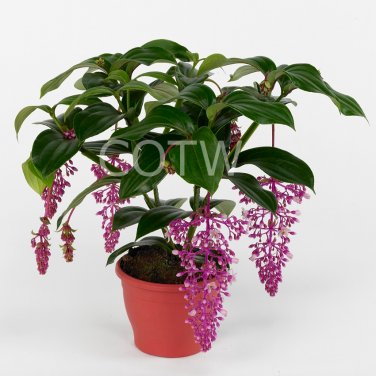
Showy Melastome Medinilla Magnifica and Medinilla cummingii

What a beauty! One of my overseas gardenfriends emailed me those pic's. This plants for me shows definatetely a "need to have" symptom.

Medinillas are very beautiful plants but unfortunately a nasty pest in the tropics. Tropical evergreen epiphytic shrub grown for its lush foliage and huge panicles of pink flowers.

Use a GOOD rich potting soil (a soil that retains water yet drains well), such as an African violet mix. Use a pot with a hole.

Watering: Keep the soil barely moist and if you use rainwater, be careful as it could be acidic. Use warm water.

Fertilizer: Feed every two weeks during the spring and summer with a water soluble fertilizer diluted by half.
Propagation: Stem cuttings with bottom heat in the spring through summer. It is best to propagate any type of cuttings in a mixture of moist peat and perlite. Cover the pot and plant with a plastic bag secured by a rubber band to prevent the moisture from escaping. Place in indirect sunlight or under a fluorescent light. Repot in its regular mix after it has been growing for a while.

Mist frequently with warm water (lime free to avoid leaf staining) and avoid drafts. Place pebbles or gravel in the drainage dish to hold water and increase the humidity, make sure the pot is sitting on the gravel and not in the water. Should be pruned after flowering and repotted every spring. Needs sufficient light to bloom.

US Source for Medinilla seeds

Digg this

Tuesday

Terrestrial Bromeliads

I've finally bought seeds of the Puya Alpestris. No, they havn't arrived yet!
(pictures are borrowed from various botanical garden sites)
This Giant Bromeliad has a caudexes like stem bearing a dense rosette of narrow , spiny Variegated leaves Shiny Light Gray Green and recurving 2 to 3 inches wide . Silvery Gray beneath. Pyramidal flower spikes over 3 ft long of funnel shaped Metallic Blue flowers and Orange anthers
. Hardy in zones 9 -10.
An indoor plant in all but the most mild wintered areas . Planted out doors it should be in full sun and protect from excessive w
inter moisture. Grow indoors as a fantastic Bromeliad specimen. A good cactus mix for soil works well , place in an area that has full sunlight.


Here are some other varieties:

Puya Mirabilis
Puya Alpestries

Puya Berteroniana
Puya Venusta
Puya Santosii

Digg this

Madagascar Colville’s Glory

We have another Seedling!

One out of 10 seeds sprouted (so far). I've learned that the "boiling heat" of 100+ degrees helped this one to come up. We hope for more of course.

Colville’s Glory (Colvillea racemosa) is a species of legume in the Fabaceae family. It’s a rare flowering tropical tree - difficult to find and cultivate.
It’s conservation status is ‘Near Threatened’.

Colville’s Glory is a beautiful, large tree from Madagascar with large pinnate leaves and very conspicuous cylindrical or cone shaped clusters of bright orange flowers that are bright red in bud. It is a sight to behold when it shows off its fiery blooms. Its grape-like clusters of velvety buds range from chameleon green to blood orange.

Digg this

Sunday

Love in a Puff

Cardiospermum Halicacabum, Heart Seed, Balloon Vine, Love in a Puff'.

I've got a nice gift from one of my trading buddies. A small plant still but thats what it's going to look like.

The balloon vine is a small climber, woody at base, with finely hairy stems. It grows with the help of opposite tendrils born under the flowers. The minute petals are white. The fruits are papery inflated capsules, light green ripening light brown, triangular.

The seeds are rounded, small, black to dark blue, with a heart-shaped white helm (hence the name, cardiospermum means heart-seed). Leaves are usually triangular, alternate, with three leaflets. The stem is thin, rounded, up to 15 feet long. The leaves are used against rheumatism (external use), as well as for treating eczema and hives.

Digg this

Saturday

Silk Floss Tree

Chorisia speciosa:
Here is an interesting Tree. Our local garden center sells these. I have not yet had the courage to get one, but the more I look it the more I am changing my mind. We'll wait till fall comes and their 70% off sale. These trees get quite large.
Great for Bonsai if seed raised

Gorgeous ornamental tree producing profuse amounts of large pink, purple, or red flowers followed by inedible fruits. The fruits split open when mature, releasing masses of white silky material.

Fast growing tree to 30-60ft tall. The floss silk tree is fairly hardy and will survive freezes. It grows very well in both tropical and subtropical climates, and is a popular street tree, due to its beautiful blooms. The trunk is also unique, containing numerous prominent spines. Leaves drop during flowering time. Grow in well drained soil. Trees do not need a lot of water, particularly during flowering.

Propagation: Propagation is usually by seed, or grafting.

Digg this

New Research Projects

MUCUNA BENNETTI -New Guinea Creeper - Mucuna - Spectacular cleret colored vine. Cold sensitive.

This plant is currently under investigation


Pyrostegia Venusta Hua Pala - An evergreen climber which is native to South America is conspicuous during Dec-Mar. for it's clusters of pendant bright-orange 3" tubular flowers with 5" long lobes which curl back to reveal it's stamens.

This plant is currently under investigation

Digg this

Deppea Splendens

How would you want one of those? Just window shopping here, as this plant is nowhere to be found for less than $100 :) And I am not willing to spend that much on a plant that might not even survive the trip. Let me know if you ever have a good Mexico source!

One of the rarest plants in cultivation. A member of the coffee family, Deppea splendens has beautiful flowers that make it a very desirable plant to have in your garden. Hanging from impossibly thin, wiry flower stems are clusters of long tubular yellow flowers that emerge from red sepels. Blooms in late Summer & Fall. The plant itself has crisp green foliage that is somewhat textured & tropical looking. The plant gets to be around 6-8’ tall and 4-5’ wide, although it reached much taller proportions in its native habitat. Needs some shade and frost protection. These are clones from the population at the San Francisco Botanical Gardens.


Digg this

Frangipani Vine

As if a Plumeria alone wasn't breath taking enouch, check out the Plumeria VINE! Impossible to find for purchase, seed or plant. But my watchful tropical eye will be scanning all areas.

This large-leafed, coarse vine sports large clusters of white blooms with a subtle fragrance, best in full sun and acid soil. Large shiny leaves, prominent veins, superb white flowers similar to Frangipani, yellow and propellor shaped, delicous rich scent. Flowers a pure white with yellow center. Use it on larger structures (trellises), or allow it to ramble over tall trees. This is a stunning vine, flowering profusely from May - July; one of the powerful lianas of the Indian and Malayan forests, climbing to the tops of the tallest trees. This plant goes dormant in subtropical climate and usually loses leaves if temperature gets below 60F, but it is somewhat cold tolerant (30-40F) and can survive mild frost for a short period.

Digg this

Tulip Tree Update

We have Babies! The first set of seeds germinated within 4 weeks. Hard to believe the seeds didn't fry at these temperatures. I've circled them in case you can't make them out :) ..I am not much of a photographer

The second picture is from my Canadian supplier. There are some better images in a previous post...


I can't wait to see this one develop!

Digg this

Monkey's Hand Tree

What a scary looking thing!

Chiranthodendron pentadactylon– Sterculiaceae (Malvaceae) - ‘Devil's Hand Tree,' 'Monkey's Hand Tree,' 'Mexican Hand Tree,' 'Árbol de la manita,' 'Flor de la manita,' 'Mano de león,' 'Palo de yaco,' 'Mano de mico,' 'Majagua,' 'Macpalxochicuahuitl' -
Once known from a single sacred specimen growing in the Valley of Toluca in México, it was revered by the Aztecs and used spiritually and medicinally. Similar to an American Gingko, this plant was later found growing wild in the mountains of the México-Guatemala border, but much of the mystique surrounding this plant remains. It's names, both common and latin, refer to the excerted stamens emerging from the flower like a clawed hand. Like its close relative, Fremontodendron, it is in the Chocolate family, and a cross between the two genera is also grown. Difficult-to-germinate seeds mean that this plant is still rare in cultivation, but there are many fine specimens dotted up and down California.

Devil's Hand Tree is a slow-growing tree that will eventually reach a rounded 50'-60', and has a very beautiful contorted branches. The wonderful large red flowers put on a great show and flower for a long season. On the ground you sometime find the 'hands' that have fallen out of the mature flowers- a strange sight indeed (pictured). A tree for full sun on the cost or part shade more inland, they are very drought tolerant once established, and can also tolerate brief dips below 20º F.

Digg this

Hymenocallis White Spider Lily

Hymenocallis caroliniana is a native plant in the Amaryllis family. It's whispy, icy white flowers are really unusual, and they’re bound to bring traffic to a dead stop along the front of any light sun to full shade border. Average to moist soil is preferred.
The one on the right is named "Tropical Giant"
Hymenocallis means "beautiful membrane" which refers to the corona that connects the stalks of the stamens for a portion of their length. Commonly known as the “Spider Lily” the 8”- 12”, attractive, almost succulent foliage, holds up well all the growing season. Flowering commences in mid to late Summer. Native from the Southeast to the midwest, I predict that it is at least zone 5 hardy if not zone 4.

Somewhat easy to grow from seed, but it takes 3 - 5 years to reach flowering size. I recommend propagation from division as it takes only a year or two to flower and some plants set several new bulbs every year.

I JUST bought 5 bulbs online for 99 cents!!!!

Digg this

Sunday

Mystery Ginger- Happy Mothers Day!


It's not a tropical secret that I love tropical plants :) Most in our garden are grown from seeds or traded with other gardeners worldwide, so usually we start small before we go big time.
Today my Husband bought me a HUGE Ginger Plant with about 6 huge rhizomes and a bloom. We discovered it while browsing through our most favorite Garden Center!!!
We don't know what kind it is yet, but we know it's HUGE. We think it's Kalihi Ginger

Thank you, Thank you, Thank you my babe!! It means especially much because my son was born on on a tropical island, which lead me to my liking of...tropical plants.

If you know a proper name of this ginger, please leave message on the post. Thanks!

Digg this

10 little Red Orchid Plants ...

Lets hope for the best!!!. 10 Seeds planted today!

One of the Orchid Tree species with brick red, orchid like flowers and notched leaves shaped like hooves.

B. galpinii if let alone grows like scandent shrub forming round mounds but it can be shaped in different ways to your liking. I have seen plants trimmed as small tree with a very oriental look, plants growing over fences, plants on trellises. Trimming should be done when the plants are waking up at the beginning of spring.

Digg this

The Royal Empress Tree

Paulownia tomentosa hardly needs any introduction. Also known as Princess Tree and Royal Paulownia, this showy, Chinese ornamental has naturalized throughout much of the Eastern U.S. and is grown as far north as Montreal. Paulownia can grow ten feet in a year, making it the world's fastest growing hardwood. Produces dense shade. Will tolerate almost any soil. Height usually about 40' at maturity.

If you need a fast growing, spectacular, blooming tree, this is it! My seed rack just received 10 stuffed peletts, nicely tucked away awaiting for us to see the, well...seedlings of a tree that grows 10 feet a year!!!!!

Digg this

Tuesday

Fruits you’ll think twice before eating

From childhood, we were taught (forcefully?) by our parents to eat whatever is served on the table, and that included fruits. They can’t be half as bad as vegetable, right?

I love veggies and fruits as well. But, let’s face it, when we were kids, we were so picky there had been unceremonious crying sessions at the dining table. These crazy-shaped fruits either naturally harvested or scientifically-bred, will get us all psyched up to eat them.

Kiwano:
Also known as horned melon, it’s origins can be traced to Africa.

If you cut it open, the somewhat slimy, green appearance can make one hesitant to draw a spoonful of this fruit. Kind of reminds me of the green slime that thrown up by the girl from The Exorcist.

It tastes like cucumber in lemon juice and the slimy, seedy texture is utterly disgusting and almost impossible to swallow.


Peter Pepper:
I don’t have to say the obvious here, right?


Digg this

New Research projects

Erythrina crista-galli- Coral Tree
German Brugmansia / Angel's Trumpet 'Super Spot'
Passiflora Parritae
Cornus florida subspecies urbiniana
Solkfloss Tree

Will post as soon as info becomes available!.....

Digg this

Saturday

Brugmansia Culebra


Isn't this something! My newest research project. eBay is my favorite book!....More soon....

Digg this

Sunday

Tree Morning Glory

This week I've received my plant trade from a garden friend in Alabama. Tree Morning Glory. Not really a tree, but definately not a vine. Lets see what come from it.

This interesting plant is in the sweetpotato family (Ipomoea) with a shrub-like growth habit. The scientific name is Ipomoea fistulosa. It is described as growing in exceedingly dry places and can be considered a xeriscape plant.The bush morning glory is the most prolific bloomers of any of the summer perennials.

The plant is covered with medium-size, light pink (there is a white form
available) blooms all summer. Blooms last only one day but clusters of blooms are formed in the axil of every leaf. Plants can get 6-8 feet tall with multiple trunks. When hard frosts kill plants, the tops should be removed; in South central Texas plants will sprout again from the hardy root system the following May. Once established the bush morning glory is a tough (drought-tolerant and heat-tolerant) plant. It blooms best in direct sun and will not bloom as well if receiving less than 8-10 hours of direct sun. Plants can be cut back monthly to encourage branching and increase blooming surface. Cutting back in July will reduce plant height and encourage a spectacular fall bloom.

I've also located seeds here: Ipomoea carnea Seeds

Other:
Bush Morning Glory, Morning Glory Tree, Badoh Negro, Borrachero, Matacabra. Syn: Ipomoea carnea ssp. fistulosa, flowering shrub, trumpet flowers

Digg this

Tuesday

Bell Tree Dahlia - Finally!!!

I can almost touch it!! Since this is the 3rd post on this plant, it's obvious that I really really wanted that plant. I got it!!!! One white, one lavender .

Dahlia imperialis or Bell tree dahlia is a member of the Dahlia genus native to Mexico, Central America and Colombia. It is a magnificent plant, reaching around 15-20 Ft, with thick, bamboo-like stems and single, downward pointing, pinkish-purple, orange-centered flowers in November/December. An attraction-seeking and rewarding plant.

It is a tuberous, herbaceous perennial, rapidly growing from the base after a dormant winter period, developing brittle, cane-like, 4-angled stems with swollen nodes and large tripinnate leaves, those near the ground soon being shed. The pendant or nodding flowerheads are 3-5" across with ray florets pink or mauvish-pink in color.

This species is fast-growing, the growth spurt being linked to shorter daylight hours, and usually comes into flower in autumn before the first frost. Propagation is by seed or by stem cuttings. Coming from warmer climes, it can be grown outside to zone 8+.


Digg this

Saturday

Pineapple Guava

Today, I've discovered the first blooms on our 2 year old Pineapple Guava tree. Hopefully this means that there is a harvest coming our way as well. But if not, no big deal, the flowers alone are magnificent.
The feijoa grows easily from seed, but the seedlings are not always true to type. Seeds are separated by squeezing the seedy pulp into a container, covering with water, and letting the liquid stand for 4 days to ferment. The seeds are then strained out and dried before sowing. The seeds will retain viability for a year or more if kept dry. Germination takes place in 3 weeks. The plant fruits in 3 - 5 years from seed.
Vegetative means are necessary to reproduce a variety. Young wood cuttings will root within two months with bottom heat and mist. Whip, tongue or veneer grafting methods are sometimes successful, as is air-layering and ground layering. Cutting-grown plants of named varieties are most desirable, because they can be trained in a variety of ways, and can be maintained as multitrunked shrubs without concern that suckers will develop into "rogue" branches..

Digg this